Central Asia has traditionally been a region inhabited by different nomad groups, who wandered the mountains and valleys with their herds. They crossed paths and met while moving around, and that meant a rich exchange of ideas, culture and materials.
Mediterranean red coral (Corallium rubrum) was one of these traveling substances. It has played a surprisingly significant role in the material culture of Central Asia, where, for centuries, coral arrived despite the region being thousands of kilometres from the sea. Coral came through long-distance trade networks which carried it among a wide range of commodities from the Mediterranean basin through Persia and into the steppe and mountain societies of Inner Asia.
The exchange system worked through the Silk Road caravans that transported coral from Sardinia, Sicily, North Africa and the Levant through Persia, Bactria, and Sogdiana and into the steppe belt and the Tarim Basin. Another route involved the Indian/Persian golf trade. The coral shipped to India was re-exported northwards through Kashmir, Fergana, and Badakhshan into nomadic territories.

Why Mediterranean coral became important in Central Asian cultures?
- Coral was a luxury trade commodity, because it arrived via merchants from the Levant, Persia, and India. Because coral could not be sourced locally, it became a rare prestige item, associated with wealth and cosmopolitanism.
- Spiritual qualities: in many Eurasian and Islamic traditions, red coral was believed to protect against the evil eye and illness. I was also believed to bring good fortune.
- Coral was also used to strengthen life force or vitality and fertility, thanks to the deep red color similar to blood -this is why deep red color was more valuable around this area than pale rose coral, which was, for some centuries, favored in Europe.
- It is a durable gem, that holds a bright and atractive color.
- Nomadic societies measured wealth in portable items, because mobility was essential. Coral—rare, bright, durable, foreign—was perfect: coral beads were small and easy to transport, so it could easily work as an exchange commodity.
The kazakh people is one of the nomadic ethnic groups that valued the use coral in their jewelry. it was mainly used in bridal ornaments like necklaces, earrings, and chest ornaments, and especially the saukele (the traditional bridal headdress). You can find good information about this extraordinary head ornament in this saukele research.
The presence of coral in bridal attire signified high family status, protection for the bride and blessings for fertility and prosperity. Sometimes coral pieces were used in amuletic pendants tied to clothing or horse tack, believed to protect riders and animals.
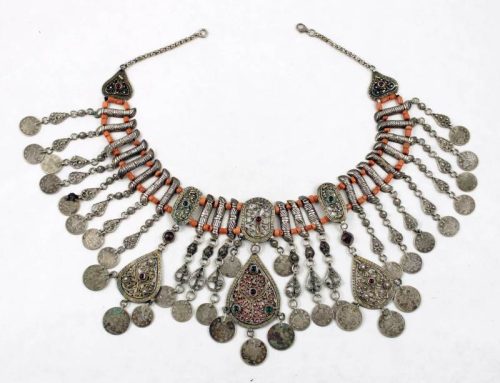
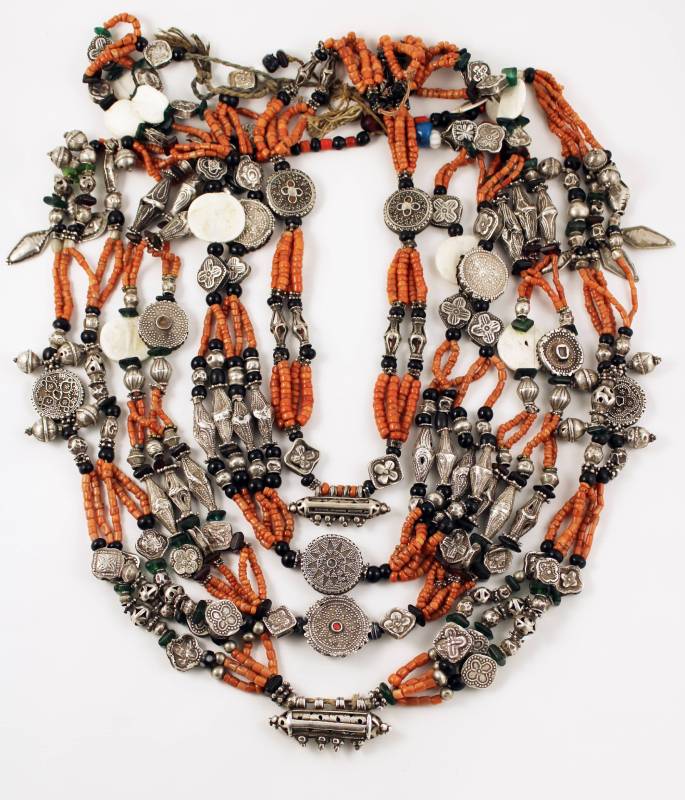
In Uzbekistan coral was used profusely in combination with silver, gilded silver, glass beads, mother of pearl, turquoise and other gems, creating stricking colorful ornaments.
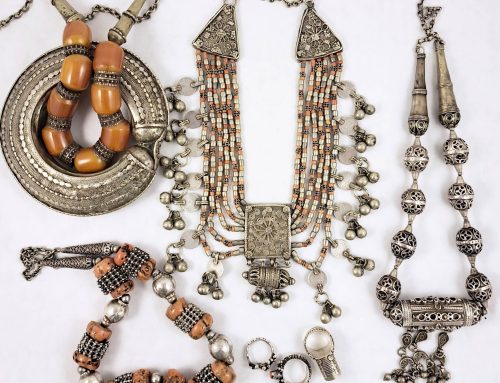
The Tajik (and especially the Pamiri people) though not nomadic in the pure steppe sense, interacted heavily with nomadic groups. Tajik jewellery developed a strong tradition of incorporating coral into their attire, adding it to women’s traditional ornaments with coral and silver necklaces and multi-strand chest ornaments. In parts of the Pamirs—where pre-Islamic beliefs blend with Islam—coral was used also as protective and ritual amulets and household talismans.
Coral used in Tajik jewelry -as in the rest of Central Asia- was considered a life-protecting stone, used to safeguard mothers and children and formed an essential part of a woman’s dowry, symbolizing both family wealth and female good fortune.