-
 Matching pair of Turkmen bracelets. Made of silver and gilded silver. According to Anne Van Cutsem, this kind of bracelets without gemstones comes from North of Afghanistan. Mid-20th century. Dimensions: Size: 7 x 5,5 x 5,5 cm Inner diameter: 6,5 cm Width: 5,5 cm Back gap: 3,8 cm Weight: 172,7 gr References: “Bracelets ethniques”, van Cutsem, Anne, Skira, 2002, p. 150 “Der Turkmenenschmuck”, Rudolph, Hermann, Museum für Völkerkunde, 1984, p. 246 “The arts and crafts of Turkestan”, Kalter, Johannes, Thames and Hudson, 1983, p. 104 CA138
 -
 Matching pair of Turkmen bracelets. According to Rudolph, the ungilded Turkmen bracelets do not form a homogeneous groupand might originate from various regions and from different Turkmen tribes or sub-tribes. First half of the20th century. Dimensions: Size (each): 8,5 x 6,3 x 5 cm Inner diameter: 5,8 cm Back gap: 3 cm Weight: 231 gr References: “Bracelets ethniques”, van Cutsem, Anne, Skira, 2002 “Der Turkmenenschmuck”, Rudolph, Hermann, Museum für Völkerkunde, 1984
 -
 Pair of Turkmen silver bracelets, from the Yomud tribe in Central Asia. These bracelets usually consists of two to four rows, sometimes of five to eight, and less frequently, of one row, like this case. They are worn in pairs. Silver, gilded silver and carnelian in table cut. From the first half of the 20th century. Provenance: European private collection. Dimensions: Size each: 7 x 6 x 5,8 cm Inner diameter: 5,8 cm Gap: 3 cm Weight: 323 g Literature: “Old silver jewellery of the Turkoman”, Schletzer, Dietrich Reimer Verlag, 1984, p. 249 “Der Turkmenenschmuck”, Rudolph, Hermann, Museum für Völkerkunde, 1984, p. 243 “Ethnic jewellery from Africa, Asia and the Pacific Islands”, The pepin Press, 2002, p. 102 “Bracelets ethniques d'afrique, d'Asie d'Océanie et d'Amérique”, van Cutsem, Anne, Skira, 2002, p. 150 “Schmuck aus Zentralasien”, Prokot, Inge and Joachim Callwey, Verlag München, 1981, p.139 CA274
 -
 Pair of Turkmen silver bracelets, from the Yomud tribe in Central Asia. These bracelets usually consists of two to four rows, sometimes of five to eight, and less frequently, of one row, like this case. They are worn in pairs. Silver, gilded silver and carnelian in table cut. From the first half of the 20th century. Provenance: European private collection. Dimensions: Size each: 7 x 6 x 4,3 cm Inner diameter: 5,5 cm Gap: 3,7 cm Weight: 256 g Literature: “Old silver jewellery of the Turkoman”, Schletzer, Dietrich Reimer Verlag, 1984, p. 249 “Der Turkmenenschmuck”, Rudolph, Hermann, Museum für Völkerkunde, 1984, p. 243 “Ethnic jewellery from Africa, Asia and the Pacific Islands”, The pepin Press, 2002, p. 102 “Bracelets ethniques d'afrique, d'Asie d'Océanie et d'Amérique”, van Cutsem, Anne, Skira, 2002, p. 150 “Schmuck aus Zentralasien”, Prokot, Inge and Joachim Callwey, Verlag München, 1981, p.139 pipturk2
 -
 Turkoman woman’s ear pendant called “tenetschir”, generally attached to a headdress, not to the ears. From the Tekke people from the oasis of Merv and Salor people from the oasis of Serachs. Materials: high-grade silver, fire-gilded silver and carnelians in table cut. From the 19th or first quarter of the 20th century. Provenance: UK private collection Dimensions: 20 x 6 cm Weight: 86 gr Literature: “Old silver jewellery of the Turkoman”, Schletzer, Dietrich Reimer Verlag, 1984, p. 184.5 “Der Turkmenenschmuck”, Rudolph, Hermann, Museum für Völkerkunde, 1984, p. 134 “A world of earrings. Africa, Asia America”, van Cutsem, Anne, Skira, 2001. p. 81 “Ethnic jewellery from Africa, Asia and the Pacific Islands”, The pepin Press, 2002, p. 96 “De kracht van Zilver. Etnische sieraden uit de collectie smith hutschenruyter”, Mols, Luitgard, Wereld Museum, Rotterdam, 2011, p. 134 “Ethnic jewellery and adornment” Daalder, Truus, Ethnic Art Press, 2009, p. 354 CA208
 -
 Elbow bracelet called “iwuki” or “aweyka”. It is a large ring carved in stone (or sometimes wood) worn by men above the elbow. It could be worn alone or with other similar bracelets. The stone is sourced in the Aïr desert. It fell into disuse at the end of the 20th century except for the Fulani Bororo (woodabé), who borrowed them from the Tuareg and wear it frequently, still today. Each shape has a different name. Inner diameter: 8,5 cm Literature: “Bijoux tuaregs”, Burner, Jean, Éditions du Fournel, 2011, p. 254 WA125
 -
 Unusual Tuareg ring, worn in West Africa. The silver has a beautiful patina and it is decorated with engraved decoration. Silver balls are attached all around the ring. Inset with a round carnelian bead which color is more red and lighter than shown in the pictures. From the first half of the 20th century. Provenance: Dutch private collection. The ring size is 9 3/4 (American size) - 20 mm diameter. The top measures 3,5 cm with the silver balls. It weighs 43,6 gr. Literature: “Bagues ethniques d'afrique, d'Asie et d'Amerique”, van Cutsem, Anne, Skira, 2000 WA119
 -
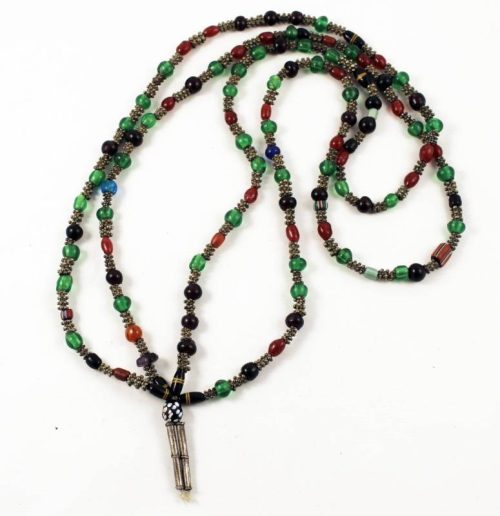 Toraja necklace made of two rows of silver and glass beads. Most of the glass beads used by the Toraja were imported or derived from trading. The silver beads were probably made by itinerant Bugis smiths. From the first half of the 20th century. Provenance: European private collection. Total length of each strand: 88 cm Weight: 170 g Literature: “Ethnic Jewelry from Indonesia”, Carpenter, Bruce W., Editions Didier Millet, 2011, p.188 “Sieraden, en lichaamsversiering uit Indonesië”, Wassing, Rita, Museum Nusantara, 1984, p.73 “Indonesische sieraden”, de Moor, Maggie & Kal, Wilhelmina K., Tropenmuseum, Amsterdam, 1983, p. 26 INDO181
 -
 Silver earrings from Central and Eastern Timor (Indonesia). Embellished with bold whorls and globules that suggest an adaptation of Portuguese and Spanish hoop earrings and resemble similarly broad hoops worn in the Philippines. From the 19th-early 20th century. Provenance: European private collection. Dimensions: 3 x 2,5 cm Combined weight: 8,4 gr Literature: “A world of earrings. Africa, Asia America”, van Cutsem, Anne, Skira, 2001 “Ethnic Jewelry from Indonesia”, Carpenter, Bruce W., Editions Didier Millet, 2011 “Gold Jewellery of the Indonesian Archipelago”. Anne Richter, Bruce W. Carpenter, ed.Didier Millet, 2011
 -
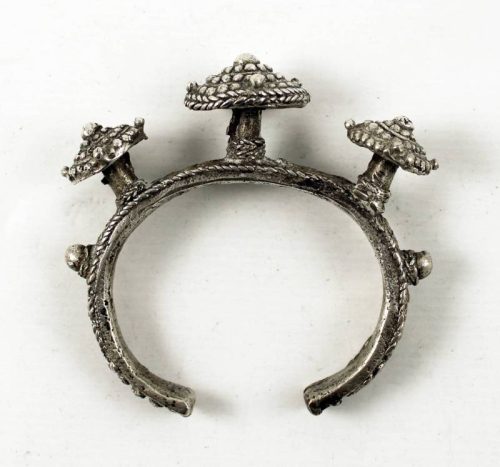 Solid silver bracelet from Timor (Indonesia). Worn bu Atoni Pah Meto warriors, who occupy most of what is now the Indonesian western half of the island. The silver ornaments were comissioned to silversmiths of Ndao and Roti, and the rijksdaalders coins from the Netherlands were melted to produce the silver. From early 20th century. Provenance: Belgian private collection. Dimensions: Total size: 8,5 x 8,5 cm Inner diameter: 5 cm Back opening: 2,5 cm Weight: 130 gr Literature: “Bracelets ethniques d'afrique, d'Asie d'Océanie et d'Amérique”, van Cutsem, Anne, Skira, 2002, p. 297 “Vanishing beauty“, The Art Institute of Chicago, 2016, p. 222 “Silver from fetish to fashion”, Nadler, Daniel and Serga, pdn publishing, 2005, p. 255 “The jewelry of Southeast Asia”, Richter, Anne, Thames & Hudson, 2000, p. 211 INDO114
 -
 Solid silver bracelet from Timor (Indonesia). Worn bu Atoni Pah Meto warriors, who occupy most of what is now the Indonesian western half of the island. The silver ornaments were comissioned to silversmiths of Ndao and Roti, and the rijksdaalders coins from the Netherlands were melted to produce the silver. From early 20th century. Provenance: Belgian private collection. Dimensions: Total size: 8 x 6 cm Inner diameter: 5,4 cm Back opening: 2,6 cm Width: 1 cm Weight: 109,7 gr Literature: “Bracelets ethniques d'afrique, d'Asie d'Océanie et d'Amérique”, van Cutsem, Anne, Skira, 2002, p. 297 “Vanishing beauty“, The Art Institute of Chicago, 2016, p. 222 “Silver from fetish to fashion”, Nadler, Daniel and Serga, pdn publishing, 2005, p. 255 “The jewelry of Southeast Asia”, Richter, Anne, Thames & Hudson, 2000, p. 211 INDO114
 -
 Solid silver bracelet from Timor (Indonesia). Worn bu Atoni Pah Meto warriors, who occupy most of what is now the Indonesian western half of the island. The silver ornaments were comissioned to silversmiths of Ndao and Roti, and the rijksdaalders coins from the Netherlands were melted to produce the silver. From early 20th century. Provenance: Belgian private collection. Dimensions: Total size: 8,5 x 6 cm Inner diameter: 6 cm Back opening: 2,8 cm Width: 1 cm Weight: 119,5 gr Literature: “Bracelets ethniques d'afrique, d'Asie d'Océanie et d'Amérique”, van Cutsem, Anne, Skira, 2002, p. 297 “Vanishing beauty“, The Art Institute of Chicago, 2016, p. 222 “Silver from fetish to fashion”, Nadler, Daniel and Serga, pdn publishing, 2005, p. 255 “The jewelry of Southeast Asia”, Richter, Anne, Thames & Hudson, 2000, p. 211 INDO116