-
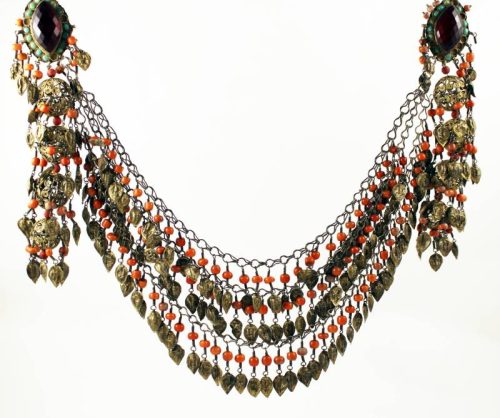 Uzbek jewellery ornament consisting in three rows of silver and coral beads with plait globular filigree hangings on each side. Khiva, Khorezm. The Khorezm bride added to her costume a pair of temple orament resembling earrings which wee attached to locks of hair on temples and linked by a necklace composed of strings of chains with stamped pendants. Gilt silver, coral, turquoises and glass cabochons. Provenance_ ex-Ghysels collection. 19th century. Literature: “Il corallo. Nell'ornamento dell'Asia islamica dalla Turchia all'Uzbekistan”, del Mare, Cristina-Vidale, Massimo, Electa napoli, 2001 “Uzbekistan. Heirs of the Silk Road”, Kalter and Pavaloi, Thames & Hudson, 1997, p. 292 “Il corallo. Nell'ornamento dell'Asia islamica dalla Turchia all'Uzbekistan”, del Mare, Cristina-Vidale, Massimo, Electa napoli, 2001, p. 52 “The arts and crafts of Turkestan”, Kalter, Johannes, Thames and Hudson, 1983, p.115 “Traditional jewellery from Soviet Central Asia and Kazakhstan”, Sovetsky khudozhnik Publishers, 1984, p. 55 “Le Monde en Tete”, Seuil, 2019, p. 115 CA280
 -
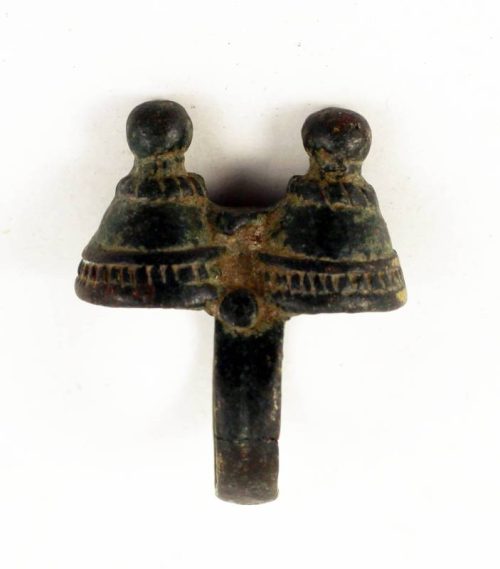 Bronze or brass toe ring, from India, most probably from Uttar Pradesh. The ring was cast with two hollow dome-shape protusions with bud-like finials. From early 20th century or older. Provenance: European private collection. Dimensions: Total size: 4 x 3,5 x 1,5 cm Size of the ring: US 6 or 16,5 cm (inner diameter). Literature: “Indian Jewellery”, Barnard, Nick, V&A publishing, timeless books, Delhi, 2008, p. 38 “Bagues ethniques d'afrique, d'Asie et d'Amerique”, van Cutsem, Anne, Skira, 2000, p. 148 IND1744
 -
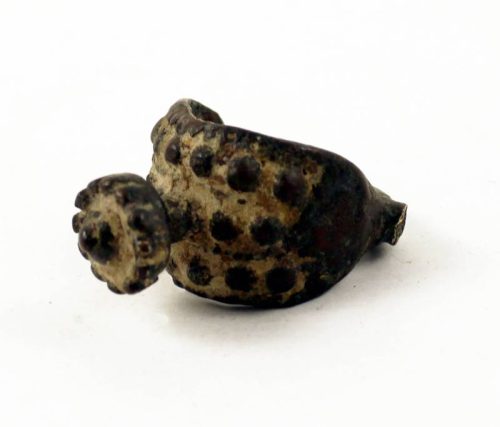 Bronze or brass toe ring, from India. The ring was cast in the shape of what it seems to be a flower. From early 20th century or older. Provenance: European private collection. Dimensions: Total size: 4,5 x 3 x 2 cm Size of the ring: US 8 1/2 or 18,5 cm (inner diameter). Literature: “Indian Jewellery”, Barnard, Nick, V&A publishing, timeless books, Delhi, 2008, p. 38 “Bagues ethniques d'afrique, d'Asie et d'Amerique”, van Cutsem, Anne, Skira, 2000, p. 148 IND1742
 -
 Amber earplugs, worn by Burmese women from the Kachin ethnic group in the 19th century. This reddish amber, or burmite, was formerly found in deposits in the North of Burma (Myanmar). From the 19th century. Length: From 9 cm Diameter: 2 cm Literature: “A world of earrings. Africa, Asia America”, van Cutsem, Anne, Skira, 2001 “The jewelry of Southeast Asia”, Richter, Anne, Thames & Hudson, 2000 BIR21
 -
 Old silver ring from Central Asia, with inset with a carnelian gemstone. High grade silver. From early 20th century. Provenance: German private collection. Size of the ring: 18 mm (inner diameter) - US size 7 3/4. CA152
 -
 Gold ear ornaments called “bela” worn by Young Ngada girls at comunal festivities. Bela are occasionally used as marriage exchange gifts and worn at ritual celebrations by the neighbouring Nagé people. Made of gold alloy. 19th century. Dimensions: 3,3 x 3 cm (each) Combined weight: 14,3 gr Provenance: German private collection. Literature: “A world of earrings. Africa, Asia America”, van Cutsem, Anne, Skira, 2001, p. 283 “L'or des Iles. Bijoux et ornements d'indonesie, malaisie et philippines”, Rodgers, Susan, Musée Barbier Mueller, Geneve, 1991, p.286 “Gold Jewellery of the Indonesian Archipelago”. Anne Richter, Bruce W. Carpenter, ed.Didier Millet, 2011, p. 175-178-179 “Sieraden, en lichaamsversiering uit Indonesië”, Wassing, Rita, Museum Nusantara, 1984, p.61 “The jewelry of Southeast Asia”, Richter, Anne, Thames & Hudson, 2000, p.209 “Ethnic Jewelry from Indonesia”, Carpenter, Bruce W., Editions Didier Millet, 2011, p.243
 -
 Silver ear ornaments called “bela” worn by Young Ngada girls at comunal festivities. Bela are occasionally used as marriage exchange gifts and worn at ritual celebrations by the neighbouring Nagé people. Made of high grade silver. A small bit of silver is missing at the bottom of one of the earrings. 19th century. Dimensions: 4,5 x 3,5 cm (each) Combined weight: 15,5 gr Provenance: European private collection. Literature: “A world of earrings. Africa, Asia America”, van Cutsem, Anne, Skira, 2001, p. 283 “L'or des Iles. Bijoux et ornements d'indonesie, malaisie et philippines”, Rodgers, Susan, Musée Barbier Mueller, Geneve, 1991, p.286 “Gold Jewellery of the Indonesian Archipelago”. Anne Richter, Bruce W. Carpenter, ed.Didier Millet, 2011, p. 175-178-179 “Sieraden, en lichaamsversiering uit Indonesië”, Wassing, Rita, Museum Nusantara, 1984, p.61 “The jewelry of Southeast Asia”, Richter, Anne, Thames & Hudson, 2000, p.209 “Ethnic Jewelry from Indonesia”, Carpenter, Bruce W., Editions Didier Millet, 2011, p.243
 -
 Old multistrand necklace, most probably from the Chin people inhabiting Western Myanmar. From mid 20th Century or older. The threads are the original ones, some in a delicate state due to wear. The necklace is 108 cm long (42,52 in). Weight: 190 gr. SEA259
 -
 Rare silver and coral necklace from Uzbekistan, most probably from the Khorezm area. First half of the 20th century. Material: coral beads, silver, glass beads and Ottoman and Russian coins. The Ottoman or Uzbek coins are old and worn, one of them is dated in 1279 (1858 CE, the other ones are worn off and it is not possible to see the date. The Russian coins are dated between 1922 and 1929. Dimensions: Length: 62 cm Size of the bigger Russian coins: 2,7 cm (diameter) Weight: 162 gr Literature: “Kyrgyzstan. Ethnic jewellery of Central Asia”, Kadyrov, V., Rarity Firm LTD, 2007, p. 21 “Il corallo. Nell'ornamento dell'Asia islamica dalla Turchia all'Uzbekistan”, del Mare, Cristina-Vidale, Massimo, Electa napoli, 2001, p. 92 CA170
 -
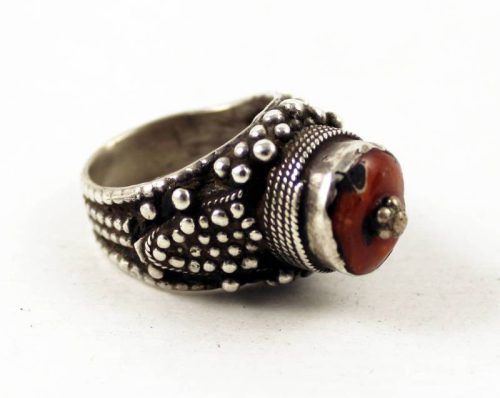 Silver and coral ring from Yemen with granulated decoration. High grade silver and coral. From the first half of the 20th. Provenance: Spanish private collection. Size of the ring: US size 8 1/2 or 18,50 mm inner diameter Literature: “Bagues ethniques d'afrique, d'Asie et d'Amerique”, van Cutsem, Anne, Skira, 2000, p. 98-99 “Silver treasures from the land of Sheba”, Ransom. Marjorie, The American university in Cairo Press, 2014, p.63 P6895
 -
 A three-strand traditional coral necklace, called"namysto", from Ukraine. In Ukranian folklore corals were used to symbolize youth and health. Bright red beads meant that the woman was strong and healthy, but dull and greyish ones warned of disease. From the 19th century or older. Provenance: European private collection. Dimensions: Length of the longest strand: 68 cm Size of the bigger central bead (diameter): 1,5 cm Weight: 134,6 gr Literature: “Splendor and shine in the river of time“, Steiner, Irene, Liechtensteinisches Landes Museum, 2020, p. 74 EUR19
 -
 A four-strand traditional coral necklace, called"namysto", from Ukraine. In Ukranian folklore corals were used to symbolize youth and health. Bright red beads meant that the woman was strong and healthy, but dull and greyish ones warned of disease. From the 19th century or older. Provenance: European private collection. Dimensions: Length of the longest strand: 68 cm Size of the bigger central bead (diameter): 1,4 cm Weight: 136,7 gr Literature: “Splendor and shine in the river of time“, Steiner, Irene, Liechtensteinisches Landes Museum, 2020, p. 74 EUR20