-
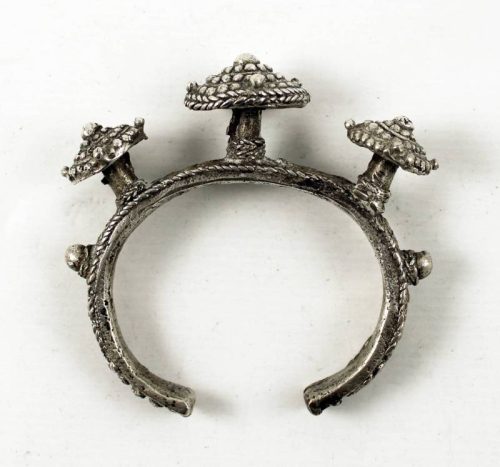 Solid silver bracelet from Timor (Indonesia). Worn bu Atoni Pah Meto warriors, who occupy most of what is now the Indonesian western half of the island. The silver ornaments were comissioned to silversmiths of Ndao and Roti, and the rijksdaalders coins from the Netherlands were melted to produce the silver. From early 20th century. Provenance: Belgian private collection. Dimensions: Total size: 8,5 x 8,5 cm Inner diameter: 5 cm Back opening: 2,5 cm Weight: 130 gr Literature: “Bracelets ethniques d'afrique, d'Asie d'Océanie et d'Amérique”, van Cutsem, Anne, Skira, 2002, p. 297 “Vanishing beauty“, The Art Institute of Chicago, 2016, p. 222 “Silver from fetish to fashion”, Nadler, Daniel and Serga, pdn publishing, 2005, p. 255 “The jewelry of Southeast Asia”, Richter, Anne, Thames & Hudson, 2000, p. 211 INDO114
 -
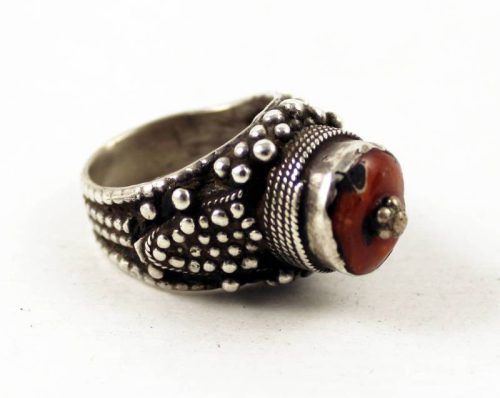 Silver and coral ring from Yemen with granulated decoration. High grade silver and coral. From the first half of the 20th. Provenance: Spanish private collection. Size of the ring: US size 8 1/2 or 18,50 mm inner diameter Literature: “Bagues ethniques d'afrique, d'Asie et d'Amerique”, van Cutsem, Anne, Skira, 2000, p. 98-99 “Silver treasures from the land of Sheba”, Ransom. Marjorie, The American university in Cairo Press, 2014, p.63 P6895
 -
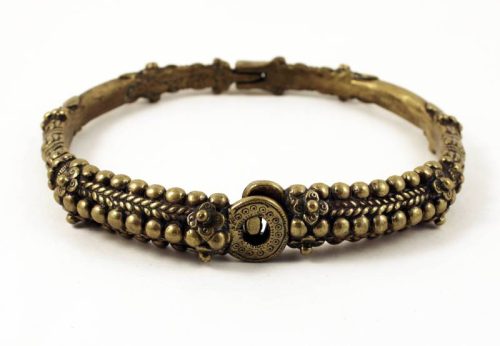 Solid bronze neck ring from Odisha, probably worn by the Bondo women. Made by the lost wax technique, The neck ring can be opened at the front. From the 19th century or early 20th. Provenance: ex Ghysels collection (see literature) Dimensions: Total size: 18 x 17 cm Inner diamenter: 147,5 cm Weight: 543,3 g Literature: “Colliers ethniques d'Afrique d'Asie, d'Océanie et d'Amérique”, Leurquin, Anne, Skira, 2003, p. 244 ND1740
 -
 Hanuman pectoral plaque, India. Worn by ascetic devotees to Hanuman, especially in Karnataka (though encountered elsewhere) suspended from the neck. Hanuman, the celebrated celestial monkey chief and devoted follower of Rama, is held in great veneration all over India by Hindu Shaivas and Shaktas, but especially in the south by Vaishnavas, because of his humility, loyalty, and assistance to Ramachandra, the seventh of the ten incarnations (dasavataras) of Vishnu. Devotees believe that his worship imbues them with physical energy, fearlessness, and mental enlightenment. Material: bronze Age: 19th century or early 20th Provenance: European private collection Dimensions: 17 x 14,5 cm Weight: 334 g Literature: “Traditional jewelry of India”, Untracht, Oppi, Harry N. Abrams. Inc publishers, 1997, p. 108-10 "Unknown Masterpieces of Indian Folk and Tribal Art", Aryan, S. & B.N. Ayran, KC Aryan’s Home of Folk Art, 2016. "Change and Continuity: Folk and Tribal Art of India", Dursum, B., et al, Lowe Art Museum, University of Miami, 2004. IND1748
 -
 A set of two identical gold amulet discs "kuwari" from south Sulawesi, Bugis people (Indonesia) The surface is finely decorated with filigree and granulation and ornamentation includes Islamic geometry (Seal of Salomon). Strung over the solar plexus with coloured twine and directly opposite on the back, they are believed to hold enormous powers that protect against disease and black magic. Although it was less common, one person sometimes wore more than one pair. The second was placed on the sides to provide extra protection against magical attack from all cardinal directions. From the 18th or 19th century. Gold content between 16 to 18 kt. Dimension each: 6,5 x 6,5 x 0,2 cm Combined weight: 54 g Literature: “Gold Jewellery of the Indonesian Archipelago”. Anne Richter, Bruce W. Carpenter, ed.Didier Millet, 2011, p. 232-247 “Ethnic Jewelry from Indonesia”, Carpenter, Bruce W., Editions Didier Millet, 2011, p. 170-73 “Power and gold: jewelry from Indonesia, Malaysia and the Philippines”, Rodgers, Susan, Presteg Verlag, Geneve, 1988, p. 288 “Magie van de vrouw”, Vanderstraete, Anne, wereldmuseum, Rotterdam, 2012, p. 327 “The jewelry of Southeast Asia”, Richter, Anne, Thames & Hudson, 2000, p. 216 “Colliers ethniques d'Afrique d'Asie, d'Océanie et d'Amérique”, Leurquin, Anne, Skira, 2003, p. 348 “Vanishing beauty“, The Art Institute of Chicago, 2016, p. 226 INDO179
 -
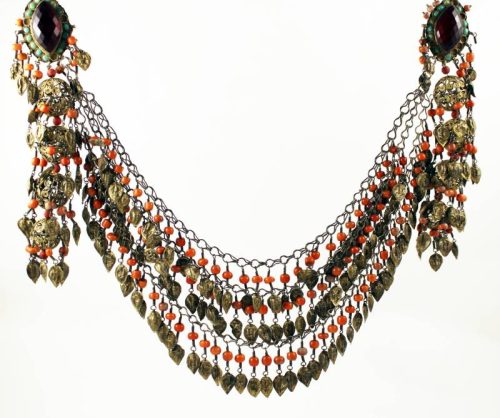 Uzbek jewellery ornament consisting in three rows of silver and coral beads with plait globular filigree hangings on each side. Khiva, Khorezm. The Khorezm bride added to her costume a pair of temple orament resembling earrings which wee attached to locks of hair on temples and linked by a necklace composed of strings of chains with stamped pendants. Gilt silver, coral, turquoises and glass cabochons. Provenance_ ex-Ghysels collection. 19th century. Literature: “Il corallo. Nell'ornamento dell'Asia islamica dalla Turchia all'Uzbekistan”, del Mare, Cristina-Vidale, Massimo, Electa napoli, 2001 “Uzbekistan. Heirs of the Silk Road”, Kalter and Pavaloi, Thames & Hudson, 1997, p. 292 “Il corallo. Nell'ornamento dell'Asia islamica dalla Turchia all'Uzbekistan”, del Mare, Cristina-Vidale, Massimo, Electa napoli, 2001, p. 52 “The arts and crafts of Turkestan”, Kalter, Johannes, Thames and Hudson, 1983, p.115 “Traditional jewellery from Soviet Central Asia and Kazakhstan”, Sovetsky khudozhnik Publishers, 1984, p. 55 “Le Monde en Tete”, Seuil, 2019, p. 115 CA280
 -
 Pectoral disc named after the moon (bulan), made of gold alloy. Pectoral discs are status symbols that originally began as emblems of greats deeds in war, headhunting or hunting. Associated with celestial bodies, depicted as great hunters in local mythology, the discs may be plain or decorated, like this one. The same discs are worn by women after they give birth, together with other warrior's ornaments. Similar discs are found in the region, especially in Maluku. The disc is adorned with a solar symbol, which is complemented on the back with a moon represented by dots, evoking the totality of the cosmos in its solar and lunar, and male and female aspects. Gold alloy between 14kt and 18 kt. Early 20th century or older. Provenance: European private collection. Diameter: 13,5 cm Length of the chain: 74 cm Weight: 100,6 gr Literature: “Ethnic Jewelry from Indonesia”, Carpenter, Bruce W., Editions Didier Millet, 2011, p. 280 “Gold Jewellery of the Indonesian Archipelago”. Anne Richter, Bruce W. Carpenter, ed.Didier Millet, 2011, p. 98, 99 “Magie van de vrouw”, Vanderstraete, Anne, wereldmuseum, Rotterdam, 2012, p. 103 “Power and gold: jewelry from Indonesia, Malaysia and the Philippines”, Rodgers, Susan, Presteg Verlag, Geneve, 1988, p. 298 “The jewelry of Southeast Asia”, Richter, Anne, Thames&Hudson, 2000, p. 210 “Colliers ethniques d'Afrique d'Asie, d'Océanie et d'Amérique”, Leurquin, Anne, Skira, 2003, p. 354 P5046
 -
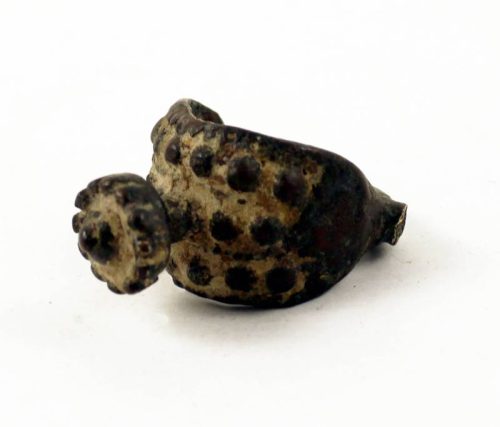 Bronze or brass toe ring, from India. The ring was cast in the shape of what it seems to be a flower. From early 20th century or older. Provenance: European private collection. Dimensions: Total size: 4,5 x 3 x 2 cm Size of the ring: US 8 1/2 or 18,5 cm (inner diameter). Literature: “Indian Jewellery”, Barnard, Nick, V&A publishing, timeless books, Delhi, 2008, p. 38 “Bagues ethniques d'afrique, d'Asie et d'Amerique”, van Cutsem, Anne, Skira, 2000, p. 148 IND1742
 -
 Gold nose ring with pearls and gemstones, from Central Asia. Women of the various peoples of Turkestan wore similar nose ornaments. Their vernacular name, arabek, confirms their Arabic origin. Attached to the right nostril, they were meant to prevent the intrusion of evil spirits during inhalation. From the first half of the 20th century or older. Provenance: UK private collection Size: 4 x 4,3 cm Weight: 6,1 g Literature: “Parures de tête ethniques d'afrique, d'Asie d'Océanie et d'Amérique”, van Cutsem, Anne, Skira, 2005 “Schmuck aus Zentralasien”, Prokot, Inge and Joachim Callwey, Verlag München, 1981, p. 150 “Uzbekistan. Heirs of the Silk Road”, Kalter and Pavaloi, Thames & Hudson, 1997, 298 “Il corallo. Nell'ornamento dell'Asia islamica dalla Turchia all'Uzbekistan”, del Mare, Cristina-Vidale, Massimo, Electa napoli, 2001, p.74 PCA2
 -
 Choker/necklace from the Kabyle region in Algeria called "tazlagt emm elherz". Made of three silver boxes, decorated with coral cabochons and enamel. The boxes are linked together by nine strings of deep red coral and striped glass beads. Silver, enamel, coral, glass. Early 20th century. The cotton strings are the original ones and might be fragile at some sections. Provenance: European private collection. Dimensions: Total length with strings: 53 cm Size of silver boxes: 3 x 2,5 x 1,5 cm Weight: 164,2 g Literature: “Jewelry from the Orient (Bir Collection)”, Seiwert, Wolf Dieter, Arnoldsche, 2009, p. 89 “L'argent de la lune”, Makilan, 2015, p. 102 “Il corallo nel gioiello etnico di Marocco e Algeria”, del Mare, Cristina; Russo, Flavio, Electa-Napoli, 2005, p. 95 “Bijoux berbères d'Algérie”, Camps-Fabrer, Edisud, 1990, p. 95 ARG144
 -
 Impressive silver belt from the Caucasus, most probably from Dagestan or Azerbaijan. The belt buckle is decorated with niello work that can be attributed to circassians. The rest of the belt is a leather band with coins sewn on them. Other coins hang all around the belt in a mesh fashion. From the 19th century or early 20th century. In good condition, some niello has faded and 2 coins from the mesh are lost. Provenance: UK private collection. Dimensions: Total length: 77 cm Belt buckle: 10 x 24 cm Height with coins: 20 cm Literature: “Ceintures ethniques d'Afrique d'Asie, d'Océanie et d'Amérique”, Leurquin, Anne, Skira, 2004, p. 132 “Jewelry from the Orient (Bir Collection)”, Seiwert, Wolf Dieter, Arnoldsche, 2009, p. 272 “Museum of the ethnography of the peoples of the USSR”, Aurora Art Publishers, Leningrad, 1988, p. 73 “Remnants of the past-Collection of Lousick Agouletsi”, Tigran mets, 2010, p. 88 CA220
 -
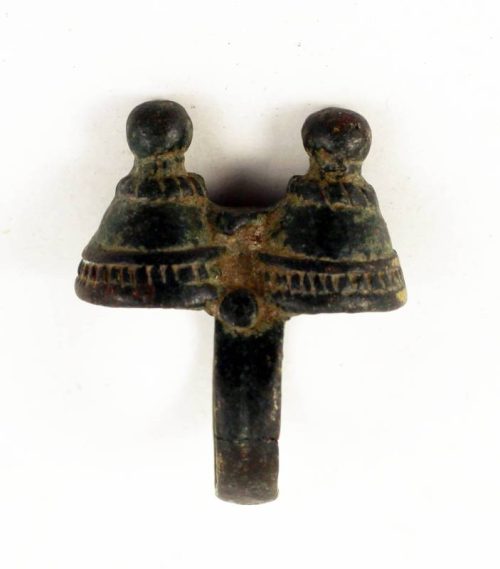 Bronze or brass toe ring, from India, most probably from Uttar Pradesh. The ring was cast with two hollow dome-shape protusions with bud-like finials. From early 20th century or older. Provenance: European private collection. Dimensions: Total size: 4 x 3,5 x 1,5 cm Size of the ring: US 6 or 16,5 cm (inner diameter). Literature: “Indian Jewellery”, Barnard, Nick, V&A publishing, timeless books, Delhi, 2008, p. 38 “Bagues ethniques d'afrique, d'Asie et d'Amerique”, van Cutsem, Anne, Skira, 2000, p. 148 IND1744