-
 A gold marriage pendant from South India, worn by women in Tamil Nadu and Kerala. The purity of gold is 22 kt. From the 19th century. The size of the pendant is 3,4 x 2,6 cm (1,34 x 1,02 inches) It weighs 4,4 gr. Literature: “When gold Blossons”, Aitken, Molly Emma, Asia Society & Philip Wilson Publishers, 2004 “Traditional Jewelry of India”, Untracht, Oppi, Harry N. Abrams. Inc publishers, 1997 “Ethnic jewellery and adornment” Daalder, Truus, Ethnic Art Press, 2009 For more information about these pendants, check our post about Gold Indian talis IND1453
 -
 Old silver pendant necklace, used as a lingam casket box. These pendants were designed as containers to hold a sacred lingam stone representing the god Shiva. Lingayats are a Hindu group who believe that Shiva is the only diety, rather than the 3 gods revered by other Hindus. They also believed that the sacred presence of Shiva was not simply confined to the temple, but that it could be held in these pendants for a personal connection to the god. You can see similar samples in “Traditional Jewelry of India” by Oppi Untracht, page133. This is an original and worn piece, in excellent condition, from the 19th Century. Provenance: Ex- Michael Backman Gallery The size of the pendant is nearly 61 mm wide by 51 mm high. The chain is 62 cm long approx. (24,4 in). It weighs 106 gr. For more information about this fascinating pieces, please see my post on Indian lingam box caskets. IND1150
 -
 Old silver pendant necklace, used as a lingam casket box. These pendants were designed as containers to hold a sacred lingam stone representing the god Shiva. High-grade silver. Lingayats are a Hindu group who believe that Shiva is the only deity, rather than the 3 gods revered by other Hindus. They also believed that the sacred presence of Shiva was not simply confined to the temple, but that it could be held in these pendants for a personal connection to the god. You can see similar samples in “Traditional jewelry of India” by Oppi Untracht, page133. This is an original and worn piece, in excellent condition, from the 19th Century. Provenance: Ex- Michael Backman Gallery The size of the pendant is nearly 61 mm wide by 52 mm high. The chain is 70 cm long approx. (27,56 in). Weight: 86 gr. For more information about this fascinating pieces, please see my post on Indian lingam box caskets. IND1153
 -
 Old silver pendant necklace, used as a lingam casket box. These pendants were designed as containers to hold a sacred lingam stone representing the god Shiva. Lingayats are a Hindu group who believe that Shiva is the only deity, rather than the 3 gods revered by other Hindus. They also believed that the sacred presence of Shiva was not simply confined to the temple, but that it could be held in these pendants for a personal connection to the god. Bibliography: “Traditional Jewelry of India” by Oppi Untracht, page133. This is an original and worn piece, in excellent condition, from the 19th Century. Provenance: Ex- Michael Backman Gallery Length of the chain: 70 cm (27,56 in) Size of pendant: 72 mm wide and 52 mm high. It weighs 151 gr. For more information about this fascinating pieces, please see my post on Indian lingam box caskets. IND1149
 -
 Old silver pendant necklace, used as a lingam casket box. These pendants were designed as containers to hold a sacred lingam stone representing the god Shiva. Lingayats are a Hindu group who believe that Shiva is the only deity, rather than the 3 gods revered by other Hindus. They also believed that the sacred presence of Shiva was not simply confined to the temple, but that it could be held in these pendants for a personal connection to the god. You can see similar samples in “Traditional Jewelry of India” by Oppi Untracht, page133. This is an original and worn piece, in excellent condition, from the 19th Century. Provenance: Ex- Michael Backman Gallery The size of the pendant is 61 mm wide by 41 mm high. The chain is 73 cm long approx. (28,74 in). It weighs 80 gr. For more information about this fascinating pieces, please see my post on Indian lingam box caskets. IND1151
 -
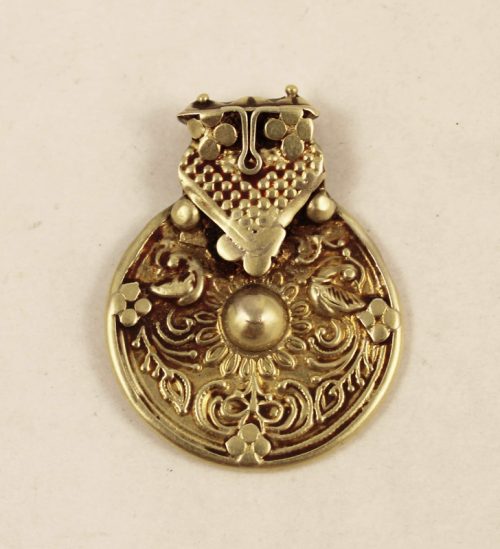 Gold marriage pendants from South India, worn by women in Tamil Nadu and Kerala. The purity of gold is at least 22 kt. From the 19th century. Provenance: Spanish private collection. The size of the pendants is 3,4 x 2,6 cm Weight: 3,4 g Literature: “When gold Blossons”, Aitken, Molly Emma, Asia Society & Philip Wilson Publishers, 2004 “Traditional Jewelry of India”, Untracht, Oppi, Harry N. Abrams. Inc publishers, 1997 “Ethnic jewellery and adornment” Daalder, Truus, Ethnic Art Press, 2009 INDN89
 -
 Big silver ornament worn on the back of the head attached to the headdress as an amulet, to protect against evil eye. Used by the Tuaregs Tel-Aïr, from Niger. It is also used as pectoral in the Hoggar region, and as temporal in certain occasions. The five triangular small pendants have also a protective meaning. One of them is missing in the central lower pendant. From the 1st half of the 20th century. Materials: Silver, leather, copper, brass, and iron on the back. Provenance: German private collection. Dimensions: Total height with leather cord: 54 cm Size of the biggest amulet: 13,5 x 16 cm Literature: “Jewelry from the Orient (Bir Collection)”, Seiwert, Wolf Dieter, Arnoldsche, 2009 “Bijoux tuaregs”, Burner, Jean, Éditions du Fournel, 2011, p.163-5 “Colliers ethniques d'Afrique d'Asie, d'Océanie et d'Amérique”, Leurquin, Anne, Skira, 2003, p. 52 “Tuaregs. Nòmades del desert“, Fundació la Caixa, 2002, p.131 WA147
 -
 Old silver pendant necklace, used as a lingam casket box. These pendants were designed as containers to hold a sacred lingam stone representing the god Shiva. With gold appliqué on the top of the casket. Lingayats are a Hindu group who believe that Shiva is the only deity, rather than the 3 gods revered by other Hindus. They also believed that the sacred presence of Shiva was not simply confined to the temple, but that it could be held in these pendants for a personal connection to the god. Bibliography: “Traditional Jewelry of India” by Oppi Untracht, page133. This is an original and worn piece, in excellent condition, from the 19th Century. Provenance: Ex- Michael Backman Gallery Length of the chain: 83 cm Size of pendant: 5,2 x 6,2 cm It weighs 98 gr. For more information about this fascinating pieces, please see my post on Indian lingam box caskets. IND1152
 -
 Old silver pendant necklace, used as a lingam casket box. These pendants were designed as containers to hold a sacred lingam stone representing the god Shiva. With gold appliqué on the top of the casket. Lingayats are a Hindu group who believe that Shiva is the only deity, rather than the 3 gods revered by other Hindus. They also believed that the sacred presence of Shiva was not simply confined to the temple, but that it could be held in these pendants for a personal connection to the god. Bibliography: “Traditional Jewelry of India” by Oppi Untracht, page133. This is an original and worn piece, in excellent condition, from the 19th Century. Provenance: Ex- Michael Backman Gallery Length of the chain: 83 cm Size of pendant: 4,5 x 6,8 cm It weighs 108 gr. For more information about this fascinating pieces, please see my post on Indian lingam box caskets. IND1148
 -
 Silver woman’s Qu’ran holder “muskalik” in a triangular shape, decorated with filigree and a turquoise gemstone, opening lid on top, and coins at the bottom and worn over the shoulder on a long chain. from Syria or Southern Anatolia. Late 19th century,or later 20th. The coins are a later addition to the pendant, which probably had a diferent kind of dangles. Coins are dated 1223 and 1255 of the Islamic calendar, which corresponds to 1801 and 1833. This kind of amulet was an export item made in various smithing centers of the core of the ottoman world (Istanbul, Damascus, Sarajevo…) following a popular trend and fashion from the second half of the 19th century. Material: High grade silver (coins), low grade silver and turquoise. Dimensions: Size of the amulet with coins: 12 x 10 cm Lenght of the chain (approx): 66 cm Literature: “The arts and crafts of Syria”, Kalter, Johannes, Thames and Hudson, 1992, p. 98 ME225
 -
 This is a rare silver box. Although it looks Persian at first sight, when examined closely it seems to be from a different region. It is still Quoran box amulet , with a lid that opens, but the decoration looks maybe Middle Eastern. It also has three bails, which suggests that it is worn, not on the forearm (as Persian/Afghans ones) but probably hanging as a pendant. It could also be from Iran or Afghanistan, a different type than the ones that are more often found, or maybe from a transitional region between the Middle East and Central Asia. Material: high grade silver and turquoise. From the first quarter of the 20th century or earlier. It is in good condition, although the hinge is fragil and needs a silver wire to be functional. Provenance: French private collection. The box was sourced in Saudi Arabia in the 60s or 70s. Dimensions (with bails): 9 x 9 x 1,8 cm Weight: 93 gr ME255
 -
 This is a rare silver box. Although it looks Persian at first sight, when examined closely it seems to be from a different region. It is still Quoran box amulet , with a lid that opens, but the decoration looks maybe Middle Eastern. It also has three bails, which suggests that it is worn, not on the forearm (as Persian/Afghans ones) but probably hanging as a pendant. It could also be from Iran or Afghanistan, a different type than the ones that are more often found, or maybe from a transitional region between the Middle East and Central Asia. Material: high grade silver. An Ottoman coin is placed at the top as decoration. From the first quarter of the 20th century or earlier . It is in good condition, although the hinge is fragil and needs a silver wire to be functional. Provenance: French private collection. The box was sourced in Saudi Arabia in the 60s or 70s. Dimensions (with bails): 9 x 9 x 1,8 cm Weight: 97,3 gr ME254