-
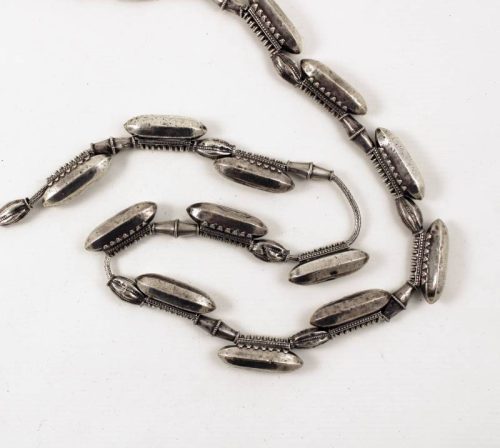 Old high-grade silver belt from Kerala, South India. Each of the pendants on this belt is an amulet, strung with silver beads on a thick “snake” chain, which fastens with a hook. High grade silver. From the first half of the 20th century. Provenance: European private collection. Dimensions: Total length: 81 cm Size of each amulet: 3,5 x 1,5 cm Weight: 116 Grams Reference: “Ceintures ethniques” Leurquin, Anne, Skira, 2004 “Silver from fetish to fashion”, Nadler, Daniel and Serga, pdn publishing, 2005 IND1741
 -
 Hanuman pectoral plaque, India. Worn by ascetic devotees to Hanuman, especially in Karnataka (though encountered elsewhere) suspended from the neck. Hanuman, the celebrated celestial monkey chief and devoted follower of Rama, is held in great veneration all over India by Hindu Shaivas and Shaktas, but especially in the south by Vaishnavas, because of his humility, loyalty, and assistance to Ramachandra, the seventh of the ten incarnations (dasavataras) of Vishnu. Devotees believe that his worship imbues them with physical energy, fearlessness, and mental enlightenment. Material: bronze Age: 19th century or early 20th Provenance: European private collection Dimensions: 17 x 14,5 cm Weight: 334 g Literature: “Traditional jewelry of India”, Untracht, Oppi, Harry N. Abrams. Inc publishers, 1997, p. 108-10 "Unknown Masterpieces of Indian Folk and Tribal Art", Aryan, S. & B.N. Ayran, KC Aryan’s Home of Folk Art, 2016. "Change and Continuity: Folk and Tribal Art of India", Dursum, B., et al, Lowe Art Museum, University of Miami, 2004. IND1748
 -
 A set of two identical gold amulet discs "kuwari" from south Sulawesi, Bugis people (Indonesia) The surface is finely decorated with filigree and granulation and ornamentation includes Islamic geometry (Seal of Salomon). Strung over the solar plexus with coloured twine and directly opposite on the back, they are believed to hold enormous powers that protect against disease and black magic. Although it was less common, one person sometimes wore more than one pair. The second was placed on the sides to provide extra protection against magical attack from all cardinal directions. From the 18th or 19th century. Gold content between 16 to 18 kt. Dimension each: 6,5 x 6,5 x 0,2 cm Combined weight: 54 g Literature: “Gold Jewellery of the Indonesian Archipelago”. Anne Richter, Bruce W. Carpenter, ed.Didier Millet, 2011, p. 232-247 “Ethnic Jewelry from Indonesia”, Carpenter, Bruce W., Editions Didier Millet, 2011, p. 170-73 “Power and gold: jewelry from Indonesia, Malaysia and the Philippines”, Rodgers, Susan, Presteg Verlag, Geneve, 1988, p. 288 “Magie van de vrouw”, Vanderstraete, Anne, wereldmuseum, Rotterdam, 2012, p. 327 “The jewelry of Southeast Asia”, Richter, Anne, Thames & Hudson, 2000, p. 216 “Colliers ethniques d'Afrique d'Asie, d'Océanie et d'Amérique”, Leurquin, Anne, Skira, 2003, p. 348 “Vanishing beauty“, The Art Institute of Chicago, 2016, p. 226 INDO179
 -
 Pectoral disc named after the moon (bulan), made of gold alloy. Pectoral discs are status symbols that originally began as emblems of greats deeds in war, headhunting or hunting. Associated with celestial bodies, depicted as great hunters in local mythology, the discs may be plain or decorated, like this one. The same discs are worn by women after they give birth, together with other warrior's ornaments. Similar discs are found in the region, especially in Maluku. The disc is adorned with a solar symbol, which is complemented on the back with a moon represented by dots, evoking the totality of the cosmos in its solar and lunar, and male and female aspects. Gold alloy between 14kt and 18 kt. Early 20th century or older. Provenance: European private collection. Diameter: 13,5 cm Length of the chain: 74 cm Weight: 100,6 gr Literature: “Ethnic Jewelry from Indonesia”, Carpenter, Bruce W., Editions Didier Millet, 2011, p. 280 “Gold Jewellery of the Indonesian Archipelago”. Anne Richter, Bruce W. Carpenter, ed.Didier Millet, 2011, p. 98, 99 “Magie van de vrouw”, Vanderstraete, Anne, wereldmuseum, Rotterdam, 2012, p. 103 “Power and gold: jewelry from Indonesia, Malaysia and the Philippines”, Rodgers, Susan, Presteg Verlag, Geneve, 1988, p. 298 “The jewelry of Southeast Asia”, Richter, Anne, Thames&Hudson, 2000, p. 210 “Colliers ethniques d'Afrique d'Asie, d'Océanie et d'Amérique”, Leurquin, Anne, Skira, 2003, p. 354 P5046
 -
 Yomud tumar amulet. pendant used as a container for some Quoran sentences or magical words. One of the sides opens to allow the storage of the paper. From the first half of the 20th century. Materials: silver, gilded silver and table-cut carnelians. Provenance: UK private collection. Dimensions: 14,5 x 15 cm Weight: 165 g Literature: “Der Turkmenenschmuck”, Rudolph, Hermann, Museum für Völkerkunde, 1984, p. 177 “Schmuck aus Zentralasien”, Prokot, Inge and Joachim Callwey, Verlag München, 1981, p. 16 “Old silver jewellery of the Turkoman”, Schletzer, Dietrich Reimer Verlag, 1984 CA214-1
 -
 Old silver omega-shape "mamuli" from Kodi, West Sumba (Indonesia). It was probably gilded. Mamuli represent female genitals. The simplest ones are an important part of the bride price paid by the groom's family. This piece of jewelry was worn in the past on exceptional occasions. At the funeral of an aristocrat, for example, the slaves of the deceased wore mamuli. Nowadays, they are worn on rare occasions in combination with the chest ornament known as marangga and with a lamba worn on the forehead to establish contact with the ancestors, or marapu. Mamuli are also placed in the folds of cloths that are wrapped around a royal corpse. The importance of these ornaments is so great that they are pictured on the grave columns erected for members of the nobility who have died. High grade silver. From the first half of the 20th century. Dimensions: 7 x 8 cm Weight: 24,6 g Literature: “Magie van de vrouw”, Vanderstraete, Anne, wereldmuseum, Rotterdam, 2012, p. 351 “The jewelry of Southeast Asia”, Richter, Anne, Thames & Hudson, 2000 “Ethnic Jewelry from Indonesia”, Carpenter, Bruce W., Editions Didier Millet, 2011, p. 203-5 “Gold Jewellery of the Indonesian Archipelago”. Anne Richter, Bruce W. Carpenter, ed.Didier Millet, 2011, p. 130-148 “Power and gold: jewelry from Indonesia, Malaysia and the Philippines”, Rodgers, Susan, Presteg Verlag, Geneve, 1988, p. 292-4 INDO173
 -
 Rare Karo Batak pendant. It shows sparse decoration woth filigree and granulation. It may have been an amulet container. Gilded silver, suasa (gold alloy). From the 19th century. Provenance: European private collection. Dimensions: 5,7 x 2,2 cm Weight: 15,3 gr Literature: “Gold Silver and Brass, jewellery of the Batak”, Sibeth, Achim, 5 Continents Editions, 2012, p. 167
 -
 Pectoral disc named after the moon (bulan), from Timor or SE Maluku. Pectoral discs are status symbols that originally began as emblems of greats deeds in war, headhunting or hunting. Associated with celestial bodies, depicted as great hunters in local mythology, the discs may be plain or decorated, like this one. The same discs are worn by women after they give birth, together with other warrior's ornaments. This rare example depicts women breasts. Made of bronze alloy. From the first half of the 20th century. Provenance: European private collection. Diameter: 17 cm Weight: 311,5 gr Literature: “Ethnic Jewelry from Indonesia”, Carpenter, Bruce W., Editions Didier Millet, 2011, p. 280 “Gold Jewellery of the Indonesian Archipelago”. Anne Richter, Bruce W. Carpenter, ed.Didier Millet, 2011, p. 98, 99 “Magie van de vrouw”, Vanderstraete, Anne, wereldmuseum, Rotterdam, 2012, p. 103 “Power and gold: jewelry from Indonesia, Malaysia and the Philippines”, Rodgers, Susan, Presteg Verlag, Geneve, 1988, p. 298 “The jewelry of Southeast Asia”, Richter, Anne, Thames & Hudson, 2000, p. 210 “Colliers ethniques d'Afrique d'Asie, d'Océanie et d'Amérique”, Leurquin, Anne, Skira, 2003, p. 354
 -
 Pectoral disc named after the moon (bulan), from Timor or SE Maluku. Pectoral discs are status symbols that originally began as emblems of greats deeds in war, headhunting or hunting. Associated with celestial bodies, depicted as great hunters in local mythology, the discs may be plain or decorated, like this one. The same discs are worn by women after they give birth, together with other warrior's ornaments. Made of silver alloy. From the first half of the 20th century. Provenance: European private collection. Diameter: 14,5 cm Weight: 45,7 gr Literature: “Ethnic Jewelry from Indonesia”, Carpenter, Bruce W., Editions Didier Millet, 2011, p. 280 “Gold Jewellery of the Indonesian Archipelago”. Anne Richter, Bruce W. Carpenter, ed.Didier Millet, 2011, p. 98, 99 “Magie van de vrouw”, Vanderstraete, Anne, wereldmuseum, Rotterdam, 2012, p. 103 “Power and gold: jewelry from Indonesia, Malaysia and the Philippines”, Rodgers, Susan, Presteg Verlag, Geneve, 1988, p. 298 “The jewelry of Southeast Asia”, Richter, Anne, Thames & Hudson, 2000, p. 210 “Colliers ethniques d'Afrique d'Asie, d'Océanie et d'Amérique”, Leurquin, Anne, Skira, 2003, p. 354
 -
 This is a rare silver box. Although it looks Persian at first sight, when examined closely it seems to be from a different region. It is still Quoran box amulet , with a lid that opens, but the decoration looks maybe Middle Eastern. It also has three bails, which suggests that it is worn, not on the forearm (as Persian/Afghans ones) but probably hanging as a pendant. It could also be from Iran or Afghanistan, a different type than the ones that are more often found, or maybe from a transitional region between the Middle East and Central Asia. Material: high grade silver. An Ottoman coin is placed at the top as decoration. From the first quarter of the 20th century or earlier . It is in good condition, although the hinge is fragil and needs a silver wire to be functional. Provenance: French private collection. The box was sourced in Saudi Arabia in the 60s or 70s. Dimensions (with bails): 9 x 9 x 1,8 cm Weight: 97,3 gr ME254
 -
 A silver amulet from Libya, in the shape of a cylinder and with vegetal and floral decoration etched and embossed on the surface. Some coral beads and small pendants intensify the amulet's power to ward off the evil eye. These containers usually hold written amulets or Ketiba in the form of verses from the Koran or undecipherable phrases appeasing formulas or spells. They may also hold perfumes. The container opens on one of the sides. High grade silver and coral. With a Tripoli silver hallmark on top. From the first half of the 20th century. Dimensions: Length of the chain: 64 cm Size of the pendant with dangles: 9 x 11 x 2,5 cm Weight: 118,2 gr Literature: "Libyan jewellery", Schenone Alberini, Elena, Araldo De Luca Editore, 1998, p. 70 "Jewelry and Adornment of Libya", Ghellali, Hala, BLKVLD, 2024, p. 102 TUN11
 -
 Tunisian silver amulet. The cylindrical hirz amulet is completed with dangles with khomsas (Fatima's hand) for extra protection. High grade silver. From the first half of the 20th century. Provenance: European private collection Dimensions: Length of the chain: 64 cm Size of the pendant with dangles: 9 x 7 cm TUN12