-
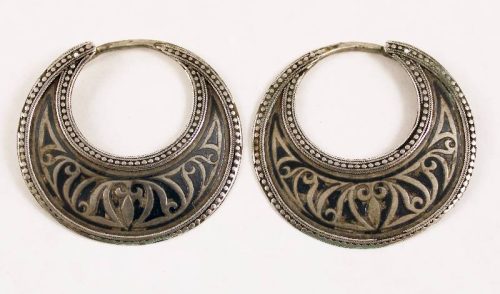 Silver and niello earrings from the Dagestan, in the Caucasus region. From the Avar people. Age: 19th century. Dimensions: Size: 6,5 x 6,8 cm Gauge: 3 mm Weight: 39,4 gr CA43
 -
 Pair of earrings with chased and niello decoration of arabesques and a piece of cloisonné enamel on the front, inset with glass, whose finesse contrasts with the pre-Saharan nature of the ornament. These are typical of the Tiznit region. Due to the size and weight of the earrings they are worn as temporals and are attached to the headdress with a chain and a decorated hook. Of exceptional craftmanship, such pieces are particularly ostentatious. The earrings are in pristine condition, no pieces missing or unmatched. From early 20th century, maybe earlier. Provenance: German private collection. Dimensions: Length of the chain: 50 cm Each earring 15 x 10,5 cm Weight: 151,4 cm Literature: “Berber Memoires”, Draguet, Michel, Mercator fonds, Yale, 2021, p. 269-271 “Splendeurs du Marroc” Editions plume, 1998, p. 253 “Bijoux du Marroc. Du Haut Atlas à la Vallée du Draa”, Rabaté, Marie-rose et Jacques, Edisuc/Le Fennec, 1996, p. 53 MAR295
 -
 Amber earplugs, worn by Burmese women from the Kachin ethnic group in the 19th century. This reddish amber, or burmite, was formerly found in deposits in the North of Burma (Myanmar). From the 19th century. Length: From 9 cm Diameter: 2 cm Literature: “A world of earrings. Africa, Asia America”, van Cutsem, Anne, Skira, 2001 “The jewelry of Southeast Asia”, Richter, Anne, Thames & Hudson, 2000 BIR21
 -
 Gold ear ornaments called “bela” worn by Young Ngada girls at comunal festivities. Bela are occasionally used as marriage exchange gifts and worn at ritual celebrations by the neighbouring Nagé people. Made of gold alloy. 19th century. Dimensions: 3,3 x 3 cm (each) Combined weight: 14,3 gr Provenance: German private collection. Literature: “A world of earrings. Africa, Asia America”, van Cutsem, Anne, Skira, 2001, p. 283 “L'or des Iles. Bijoux et ornements d'indonesie, malaisie et philippines”, Rodgers, Susan, Musée Barbier Mueller, Geneve, 1991, p.286 “Gold Jewellery of the Indonesian Archipelago”. Anne Richter, Bruce W. Carpenter, ed.Didier Millet, 2011, p. 175-178-179 “Sieraden, en lichaamsversiering uit Indonesië”, Wassing, Rita, Museum Nusantara, 1984, p.61 “The jewelry of Southeast Asia”, Richter, Anne, Thames & Hudson, 2000, p.209 “Ethnic Jewelry from Indonesia”, Carpenter, Bruce W., Editions Didier Millet, 2011, p.243
 -
 Silver ear ornaments called “bela” worn by Young Ngada girls at comunal festivities. Bela are occasionally used as marriage exchange gifts and worn at ritual celebrations by the neighbouring Nagé people. Made of high grade silver. A small bit of silver is missing at the bottom of one of the earrings. 19th century. Dimensions: 4,5 x 3,5 cm (each) Combined weight: 15,5 gr Provenance: European private collection. Literature: “A world of earrings. Africa, Asia America”, van Cutsem, Anne, Skira, 2001, p. 283 “L'or des Iles. Bijoux et ornements d'indonesie, malaisie et philippines”, Rodgers, Susan, Musée Barbier Mueller, Geneve, 1991, p.286 “Gold Jewellery of the Indonesian Archipelago”. Anne Richter, Bruce W. Carpenter, ed.Didier Millet, 2011, p. 175-178-179 “Sieraden, en lichaamsversiering uit Indonesië”, Wassing, Rita, Museum Nusantara, 1984, p.61 “The jewelry of Southeast Asia”, Richter, Anne, Thames & Hudson, 2000, p.209 “Ethnic Jewelry from Indonesia”, Carpenter, Bruce W., Editions Didier Millet, 2011, p.243
 -
 Ethnic earrings from the Dong people, living in Guizhou, South China. From the beginning to mid 20th century. Fine filigree work and high-quality silver, with a wonderful patina. The earrings were filled at some point with wool for decoration. In a fairly good state, just one of the small silver balls is missing. They are 6 cm long (2,36 in) and they both weigh 28 gr. SEA238
 -
 Indian gold nose ring with pearls, 22 kt gold, turquoise and glass beads. Worn in the North West area of Rajasthan around Bikaner and Jaisalmer. First half of the 20th century. Provenance: European private collection. Dimensions: 5,5 x 4 cm Weight: 9,9 gr. Literature: “Nose rings of India”, Ganguly, Waltraud, BR publishing Corporation, 2015 “Parures ethniques. Le culte de la beauté”, Geoffroy-Schneiter, Bérénice, Assouline, Paris, 2001 PIPIND
 -
 Indian gold nose ring with pearls, 22 kt gold, pearls and glass beads. Worn mainly in Rajasthan . First half of the 20th century. Provenance: European private collection. Dimensions:4 x 3,3 cm Weight: 5,5 gr. Literature: “Nose rings of India”, Ganguly, Waltraud, BR publishing Corporation, 2015 “Parures ethniques. Le culte de la beauté”, Geoffroy-Schneiter, Bérénice, Assouline, Paris, 2001 PIPIND1
 -
 Indian gold nose ring with 22 kt gold, pearls, gemstones and glass beads. Worn mainly in Rajasthan . First half of the 20th century. Provenance: European private collection. Dimensions:3 x 2,7 cm Weight: 4,8 gr. Literature: “Nose rings of India”, Ganguly, Waltraud, BR publishing Corporation, 2015 “Parures ethniques. Le culte de la beauté”, Geoffroy-Schneiter, Bérénice, Assouline, Paris, 2001 PIPIND2
 -
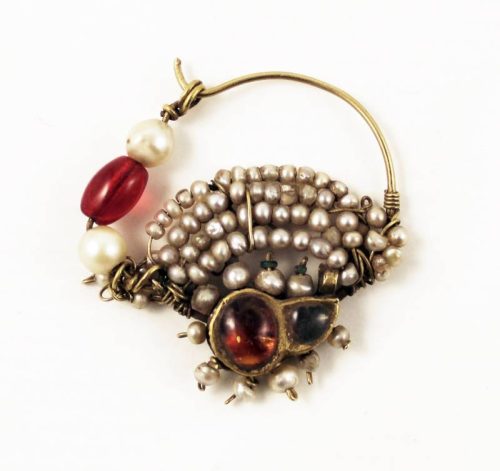 Indian gold nose ring with 22 kt gold, pearls, and glass beads. Worn mainly in Rajasthan . First half of the 20th century. Provenance: European private collection. Dimensions:3,2 x 3 cm Weight: 4 gr. Literature: “Nose rings of India”, Ganguly, Waltraud, BR publishing Corporation, 2015 “Parures ethniques. Le culte de la beauté”, Geoffroy-Schneiter, Bérénice, Assouline, Paris, 2001 PIPIND3
 -
 Gold earrings from the Balkans region or Greece. Materials: 22 kt gold, pearls and glass. From the first half of the 20th century or earlier. Size: 4 x 2 cm Combined weight: 7 gr Pbal
 -
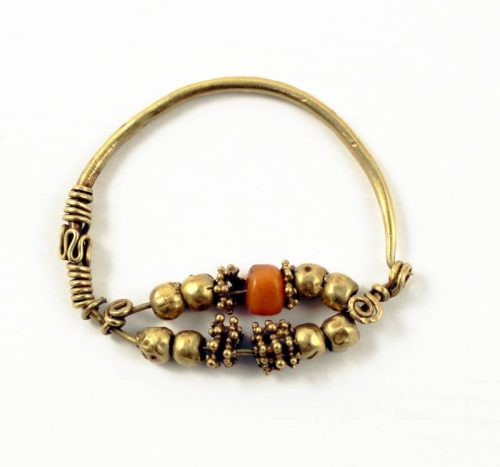 Gold nose ring with coral, from Central Asia. Women of the various peoples of Turkestan wore similar nose ornaments. Their vernacular name, arabek, confirms their Arabic origin. Attached to the right nostril, they were meant to prevent the intrusion of evil spirits during inhalation. From the first half of the 20th century or older. Provenance: UK private collection Size: 3,3 x 3,6 cm Weight: 5 g Literature: “Parures de tête ethniques d'afrique, d'Asie d'Océanie et d'Amérique”, van Cutsem, Anne, Skira, 2005 “Schmuck aus Zentralasien”, Prokot, Inge and Joachim Callwey, Verlag München, 1981, p. 150 “Uzbekistan. Heirs of the Silk Road”, Kalter and Pavaloi, Thames & Hudson, 1997, 298 “Il corallo. Nell'ornamento dell'Asia islamica dalla Turchia all'Uzbekistan”, del Mare, Cristina-Vidale, Massimo, Electa napoli, 2001, p.74 PCA1