-
 Gold nose ring with pearls and gemstones, from Central Asia. Women of the various peoples of Turkestan wore similar nose ornaments. Their vernacular name, arabek, confirms their Arabic origin. Attached to the right nostril, they were meant to prevent the intrusion of evil spirits during inhalation. From the first half of the 20th century or older. Provenance: UK private collection Size: 4 x 4,3 cm Weight: 6,1 g Literature: “Parures de tête ethniques d'afrique, d'Asie d'Océanie et d'Amérique”, van Cutsem, Anne, Skira, 2005 “Schmuck aus Zentralasien”, Prokot, Inge and Joachim Callwey, Verlag München, 1981, p. 150 “Uzbekistan. Heirs of the Silk Road”, Kalter and Pavaloi, Thames & Hudson, 1997, 298 “Il corallo. Nell'ornamento dell'Asia islamica dalla Turchia all'Uzbekistan”, del Mare, Cristina-Vidale, Massimo, Electa napoli, 2001, p.74 PCA2
 -
 Gold nose ring with pearls and glass beads, from Central Asia. Women of the various peoples of Turkestan wore similar nose ornaments. Their vernacular name, arabek, confirms their Arabic origin. Attached to the right nostril, they were meant to prevent the intrusion of evil spirits during inhalation. From the first half of the 20th century or older. Provenance: UK private collection Size: 3,6 x 3,6 cm Weight: 6,8 g Literature: “Parures de tête ethniques d'afrique, d'Asie d'Océanie et d'Amérique”, van Cutsem, Anne, Skira, 2005 “Schmuck aus Zentralasien”, Prokot, Inge and Joachim Callwey, Verlag München, 1981, p. 150 “Uzbekistan. Heirs of the Silk Road”, Kalter and Pavaloi, Thames & Hudson, 1997, 298 “Il corallo. Nell'ornamento dell'Asia islamica dalla Turchia all'Uzbekistan”, del Mare, Cristina-Vidale, Massimo, Electa napoli, 2001, p.74 PCA3
 -
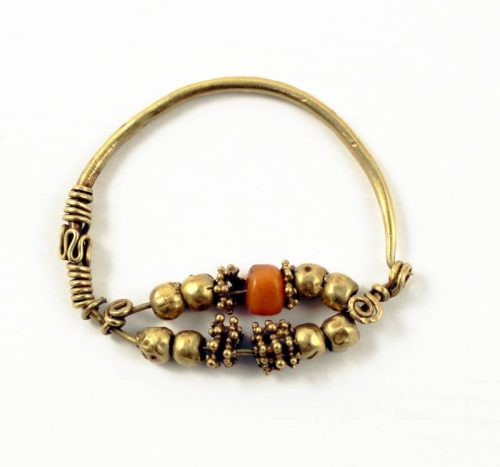 Gold nose ring with coral, from Central Asia. Women of the various peoples of Turkestan wore similar nose ornaments. Their vernacular name, arabek, confirms their Arabic origin. Attached to the right nostril, they were meant to prevent the intrusion of evil spirits during inhalation. From the first half of the 20th century or older. Provenance: UK private collection Size: 3,3 x 3,6 cm Weight: 5 g Literature: “Parures de tête ethniques d'afrique, d'Asie d'Océanie et d'Amérique”, van Cutsem, Anne, Skira, 2005 “Schmuck aus Zentralasien”, Prokot, Inge and Joachim Callwey, Verlag München, 1981, p. 150 “Uzbekistan. Heirs of the Silk Road”, Kalter and Pavaloi, Thames & Hudson, 1997, 298 “Il corallo. Nell'ornamento dell'Asia islamica dalla Turchia all'Uzbekistan”, del Mare, Cristina-Vidale, Massimo, Electa napoli, 2001, p.74 PCA1
 -
 Gold nose ring with coral and glass beads, from Central Asia. Women of the various peoples of Turkestan wore similar nose ornaments. Their vernacular name, arabek, confirms their Arabic origin. Attached to the right nostril, they were meant to prevent the intrusion of evil spirits during inhalation. Some of the granulation of the central rossette is missing. From the first half of the 20th century or older. Provenance: UK private collection Size: 4 x 3,5 cm Weight: 7,3 g Literature: “Parures de tête ethniques d'afrique, d'Asie d'Océanie et d'Amérique”, van Cutsem, Anne, Skira, 2005 “Schmuck aus Zentralasien”, Prokot, Inge and Joachim Callwey, Verlag München, 1981, p. 150 “Uzbekistan. Heirs of the Silk Road”, Kalter and Pavaloi, Thames & Hudson, 1997, 298 “Il corallo. Nell'ornamento dell'Asia islamica dalla Turchia all'Uzbekistan”, del Mare, Cristina-Vidale, Massimo, Electa napoli, 2001, p.74 PCA4
 -
 Gold earrings from the Balkans region or Greece. Materials: 22 kt gold, pearls and glass. From the first half of the 20th century or earlier. Size: 4 x 2 cm Combined weight: 7 gr Pbal
 -
 Indian gold nose ring with pearls, 22 kt gold, turquoise and glass beads. Worn in the North West area of Rajasthan around Bikaner and Jaisalmer. First half of the 20th century. Provenance: European private collection. Dimensions: 5,5 x 4 cm Weight: 9,9 gr. Literature: “Nose rings of India”, Ganguly, Waltraud, BR publishing Corporation, 2015 “Parures ethniques. Le culte de la beauté”, Geoffroy-Schneiter, Bérénice, Assouline, Paris, 2001 PIPIND
 -
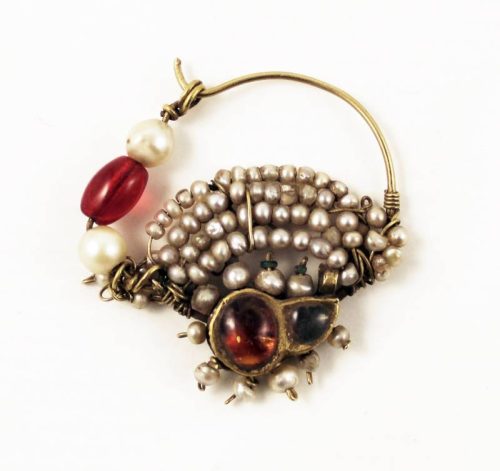 Indian gold nose ring with 22 kt gold, pearls, and glass beads. Worn mainly in Rajasthan . First half of the 20th century. Provenance: European private collection. Dimensions:3,2 x 3 cm Weight: 4 gr. Literature: “Nose rings of India”, Ganguly, Waltraud, BR publishing Corporation, 2015 “Parures ethniques. Le culte de la beauté”, Geoffroy-Schneiter, Bérénice, Assouline, Paris, 2001 PIPIND3
 -
 Indian gold nose ring with 22 kt gold, pearls, gemstones and glass beads. Worn mainly in Rajasthan . First half of the 20th century. Provenance: European private collection. Dimensions:3 x 2,7 cm Weight: 4,8 gr. Literature: “Nose rings of India”, Ganguly, Waltraud, BR publishing Corporation, 2015 “Parures ethniques. Le culte de la beauté”, Geoffroy-Schneiter, Bérénice, Assouline, Paris, 2001 PIPIND2
 -
 Indian gold nose ring with pearls, 22 kt gold, pearls and glass beads. Worn mainly in Rajasthan . First half of the 20th century. Provenance: European private collection. Dimensions:4 x 3,3 cm Weight: 5,5 gr. Literature: “Nose rings of India”, Ganguly, Waltraud, BR publishing Corporation, 2015 “Parures ethniques. Le culte de la beauté”, Geoffroy-Schneiter, Bérénice, Assouline, Paris, 2001 PIPIND1
 -
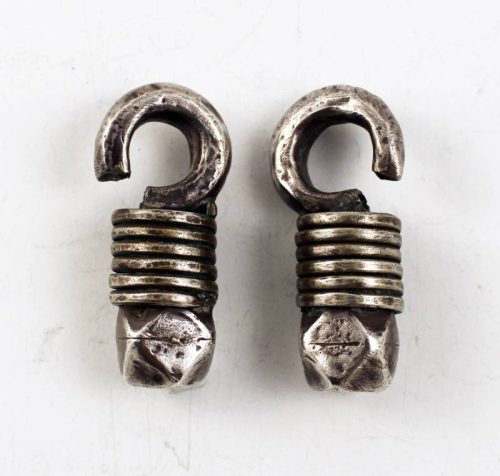 Vedha silver hollow earrings are worn by Bhopa Rabari women in Gujarat, India. This is the oldest type of Bhopa earrings and are now worn only by few old women. In India a large earlobe is a sign of strength and vitality. Provenance: European private collection. From the first half of the 20th century. Dimensions: 5,5 x 2 x 2 cm Weight: 46,8 g Gauge (approx.): 0,8 cm Literature: “A world of earrings. Africa, Asia America”, van Cutsem, Anne, Skira, 2001, p. 144 “Earrings. Ornamental identity and beauty in India”, Ganguly, Waltraud, B.R. Publishing Corporation, 2007, p. 98 “Traditional jewelry of India”, Untracht, Oppi, Harry N. Abrams. Inc publishers, 1997, p. 220 “Ethnic jewellery from Africa, Asia and the Pacific Islands”, The pepin Press, 2002, p. 135 IND1727
 -
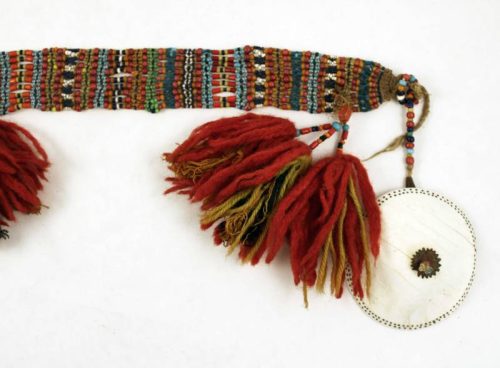 Conch shell ornaments used by Konyak men. The shell pieces are linked through a band made of tiny glass seed beads. Conch shell was highly appreciated by Naga people, as it had to be imported from the Bengala Bay. Materials: conch shell, glass beads, wool. From early 20th century. Dimensions: Shell ornament (each): 8,7 cm Beaded band: 46 cm Weight: 106,5 g Literature: “The Nagas”,Jacobs, Julian, Edition Hansjörg Mayer, 2012, p. 232, 233 “The Naga. Awe-inspiring beauty”, Draguet, M., Mercatorfonds, 2018, p.324 “A world of earrings. Africa, Asia America”, van Cutsem, Anne, Skira, 2001, p. 148-9 "Naga Treasures: Tribal Adornment from the Nagas – India and Myanmar", Giehmann, M., 2001
 -
 Uzbek silver and coral earrings "chalka" from Bukhara. First half of the 20th century. Provenance: UK private collection. Size: 8,3 x 3,5 cm Weight: 24,6 g Literature: “A world of earrings. Africa, Asia America”, van Cutsem, Anne, Skira, 2001, p. 88-89 “Schmuck aus Zentralasien”, Prokot, Inge and Joachim Callwey, Verlag München, 1981, p. 150 “A song in metal. Folk Art of Uzbekistan”, Abdullayev, T, Gafur Gulyam Art and Literature Publishers, Tashkent, 1986, p. 211 “Il corallo. Nell'ornamento dell'Asia islamica dalla Turchia all'Uzbekistan”, del Mare, Cristina-Vidale, Massimo, Electa napoli, 2001, p. 58 CA219