-
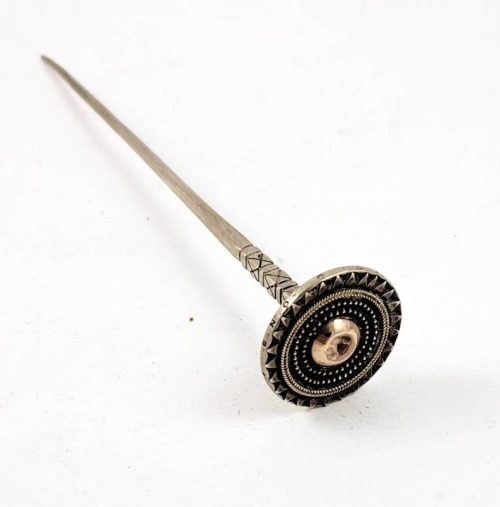 Rare hair pin made of high grade silver and suasa (an alloy of gold and copper), most probably from the Gayo Alas people of Sumatra (Indonesia). The top of the pin is made of two dutch old guilder coins, to which the pin was attached on one side and some applied decoration to the other side. From the 19th century or early 20th. Provenance: European private collection. Dimensions: Total length: 14,5 cm Top of the pin: 3 cm (diameter) P2085
 -
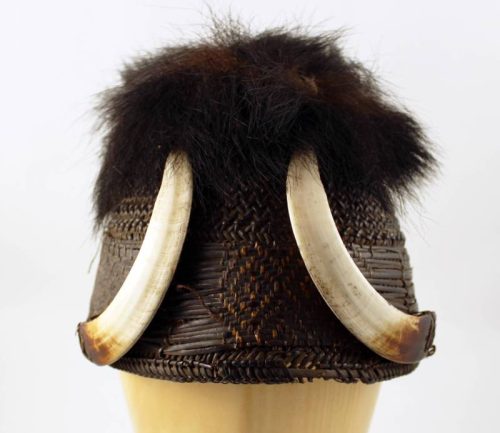 Naga warrior hat, from the Naga tribes inhabiting the hills around the Burma/India border. Materials: rattan, fur (according to Jacobs, it is usually bear's fur) and wild boad tusks. From the first half of the 20th century. Provenance: European private collection. Dimensions: 21 x 21 x 16 cm Literature: “The Naga”, Jacobs, Julian, Edition Hansjörg Mayer, 2012 “Naga, Awe inspiring beauty”, Draguet, Michel, Mercatorfonds, 2018 “Arte Naga”, Museo Nacional de Etnologia,Madrid, 1988 “Le Monde en Tete”, Seuil, 2019 CM00431
 -
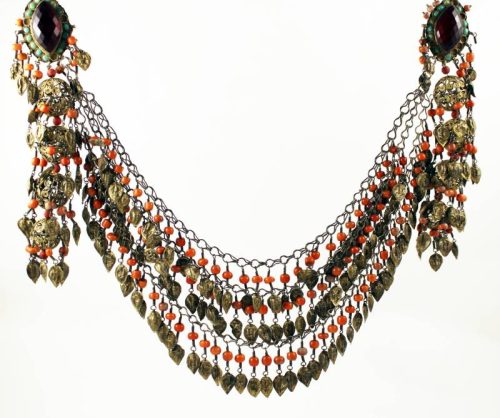 Uzbek jewellery ornament consisting in three rows of silver and coral beads with plait globular filigree hangings on each side. Khiva, Khorezm. The Khorezm bride added to her costume a pair of temple orament resembling earrings which wee attached to locks of hair on temples and linked by a necklace composed of strings of chains with stamped pendants. Gilt silver, coral, turquoises and glass cabochons. Provenance_ ex-Ghysels collection. 19th century. Literature: “Il corallo. Nell'ornamento dell'Asia islamica dalla Turchia all'Uzbekistan”, del Mare, Cristina-Vidale, Massimo, Electa napoli, 2001 “Uzbekistan. Heirs of the Silk Road”, Kalter and Pavaloi, Thames & Hudson, 1997, p. 292 “Il corallo. Nell'ornamento dell'Asia islamica dalla Turchia all'Uzbekistan”, del Mare, Cristina-Vidale, Massimo, Electa napoli, 2001, p. 52 “The arts and crafts of Turkestan”, Kalter, Johannes, Thames and Hudson, 1983, p.115 “Traditional jewellery from Soviet Central Asia and Kazakhstan”, Sovetsky khudozhnik Publishers, 1984, p. 55 “Le Monde en Tete”, Seuil, 2019, p. 115 CA280
 -
 Gold nose ring with pearls and gemstones, from Central Asia. Women of the various peoples of Turkestan wore similar nose ornaments. Their vernacular name, arabek, confirms their Arabic origin. Attached to the right nostril, they were meant to prevent the intrusion of evil spirits during inhalation. From the first half of the 20th century or older. Provenance: UK private collection Size: 4 x 4,3 cm Weight: 6,1 g Literature: “Parures de tête ethniques d'afrique, d'Asie d'Océanie et d'Amérique”, van Cutsem, Anne, Skira, 2005 “Schmuck aus Zentralasien”, Prokot, Inge and Joachim Callwey, Verlag München, 1981, p. 150 “Uzbekistan. Heirs of the Silk Road”, Kalter and Pavaloi, Thames & Hudson, 1997, 298 “Il corallo. Nell'ornamento dell'Asia islamica dalla Turchia all'Uzbekistan”, del Mare, Cristina-Vidale, Massimo, Electa napoli, 2001, p.74 PCA2
 -
 Gold nose ring with pearls and glass beads, from Central Asia. Women of the various peoples of Turkestan wore similar nose ornaments. Their vernacular name, arabek, confirms their Arabic origin. Attached to the right nostril, they were meant to prevent the intrusion of evil spirits during inhalation. From the first half of the 20th century or older. Provenance: UK private collection Size: 3,6 x 3,6 cm Weight: 6,8 g Literature: “Parures de tête ethniques d'afrique, d'Asie d'Océanie et d'Amérique”, van Cutsem, Anne, Skira, 2005 “Schmuck aus Zentralasien”, Prokot, Inge and Joachim Callwey, Verlag München, 1981, p. 150 “Uzbekistan. Heirs of the Silk Road”, Kalter and Pavaloi, Thames & Hudson, 1997, 298 “Il corallo. Nell'ornamento dell'Asia islamica dalla Turchia all'Uzbekistan”, del Mare, Cristina-Vidale, Massimo, Electa napoli, 2001, p.74 PCA3
 -
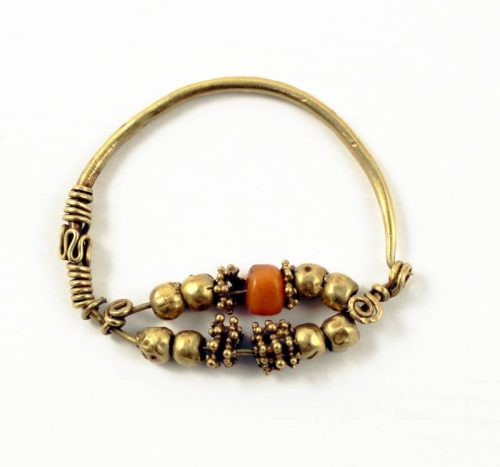 Gold nose ring with coral, from Central Asia. Women of the various peoples of Turkestan wore similar nose ornaments. Their vernacular name, arabek, confirms their Arabic origin. Attached to the right nostril, they were meant to prevent the intrusion of evil spirits during inhalation. From the first half of the 20th century or older. Provenance: UK private collection Size: 3,3 x 3,6 cm Weight: 5 g Literature: “Parures de tête ethniques d'afrique, d'Asie d'Océanie et d'Amérique”, van Cutsem, Anne, Skira, 2005 “Schmuck aus Zentralasien”, Prokot, Inge and Joachim Callwey, Verlag München, 1981, p. 150 “Uzbekistan. Heirs of the Silk Road”, Kalter and Pavaloi, Thames & Hudson, 1997, 298 “Il corallo. Nell'ornamento dell'Asia islamica dalla Turchia all'Uzbekistan”, del Mare, Cristina-Vidale, Massimo, Electa napoli, 2001, p.74 PCA1
 -
 Gold nose ring with coral and glass beads, from Central Asia. Women of the various peoples of Turkestan wore similar nose ornaments. Their vernacular name, arabek, confirms their Arabic origin. Attached to the right nostril, they were meant to prevent the intrusion of evil spirits during inhalation. Some of the granulation of the central rossette is missing. From the first half of the 20th century or older. Provenance: UK private collection Size: 4 x 3,5 cm Weight: 7,3 g Literature: “Parures de tête ethniques d'afrique, d'Asie d'Océanie et d'Amérique”, van Cutsem, Anne, Skira, 2005 “Schmuck aus Zentralasien”, Prokot, Inge and Joachim Callwey, Verlag München, 1981, p. 150 “Uzbekistan. Heirs of the Silk Road”, Kalter and Pavaloi, Thames & Hudson, 1997, 298 “Il corallo. Nell'ornamento dell'Asia islamica dalla Turchia all'Uzbekistan”, del Mare, Cristina-Vidale, Massimo, Electa napoli, 2001, p.74 PCA4
 -
 Indian gold nose ring with pearls, 22 kt gold, turquoise and glass beads. Worn in the North West area of Rajasthan around Bikaner and Jaisalmer. First half of the 20th century. Provenance: European private collection. Dimensions: 5,5 x 4 cm Weight: 9,9 gr. Literature: “Nose rings of India”, Ganguly, Waltraud, BR publishing Corporation, 2015 “Parures ethniques. Le culte de la beauté”, Geoffroy-Schneiter, Bérénice, Assouline, Paris, 2001 PIPIND
 -
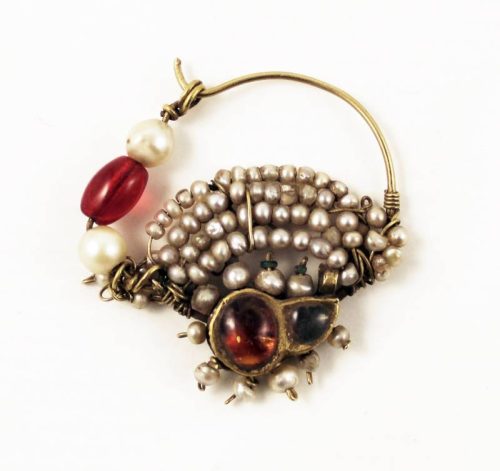 Indian gold nose ring with 22 kt gold, pearls, and glass beads. Worn mainly in Rajasthan . First half of the 20th century. Provenance: European private collection. Dimensions:3,2 x 3 cm Weight: 4 gr. Literature: “Nose rings of India”, Ganguly, Waltraud, BR publishing Corporation, 2015 “Parures ethniques. Le culte de la beauté”, Geoffroy-Schneiter, Bérénice, Assouline, Paris, 2001 PIPIND3
 -
 Indian gold nose ring with 22 kt gold, pearls, gemstones and glass beads. Worn mainly in Rajasthan . First half of the 20th century. Provenance: European private collection. Dimensions:3 x 2,7 cm Weight: 4,8 gr. Literature: “Nose rings of India”, Ganguly, Waltraud, BR publishing Corporation, 2015 “Parures ethniques. Le culte de la beauté”, Geoffroy-Schneiter, Bérénice, Assouline, Paris, 2001 PIPIND2
 -
 Indian gold nose ring with pearls, 22 kt gold, pearls and glass beads. Worn mainly in Rajasthan . First half of the 20th century. Provenance: European private collection. Dimensions:4 x 3,3 cm Weight: 5,5 gr. Literature: “Nose rings of India”, Ganguly, Waltraud, BR publishing Corporation, 2015 “Parures ethniques. Le culte de la beauté”, Geoffroy-Schneiter, Bérénice, Assouline, Paris, 2001 PIPIND1
 -
 Rare, large, disc-shaped headdress of the Bedouin women in Libya, cast from pure silver, known as ‘Salha’ or ‘Turraha’. With three hallmarks from the city of Tripoli on the front side. These large ornamental discs made of silver were worn on the head of Bedouin women in Libya for their wedding. They had different names from tribe to tribe and across the region: ‘Salha’, ‘Sualah’, ‘Turraha’, ‘Zerad’ etc. An extremely rare ornament, with traces of use but no damage. First half of the 20th century or earlier. Diameter: 14 cm. Weight: 104,8 g Literature: “Libyan jewellery”, Schenone Alberini, Elena, Araldo de Luca editore, 1998, p. 47 “Jewelry and Adornment of Libya”, Ghellali, Hala, BLKVLD, 2024, p. 69 “Amazics. Joies berebers”, IEMed, 2005, p. 124 TUN16
 -
 Timor Warrior's head band (Atoni tribe), Indonesia. In the past, warriors, meo, would wear a woven headband decorated with sewn-on silver discs around their heads. Endowed with a sacred character, headhunting was a type of initiation ritual that confirmed the meo's accession to the status of invulnerable man. Cotton, silver, and glass beads. Provenance: Spanish private collection. Dimensions:98 x 9 cm Literature: “Parures ethniques. Le culte de la beauté”, Geoffroy-Schneiter, Bérénice, Assouline, Paris, 2001, p. 221 “Ethnic jewellery from Africa, Asia and the Pacific Islands”, The pepin Press, 2002, p.240 “Power and gold: jewelry from Indonesia, Malaysia and the Philippines”, Rodgers, Susan, Presteg Verlag, Geneve, 1988, p. 150 “Ethnic Jewelry from Indonesia”, Carpenter, Bruce W., Editions Didier Millet, 2011, p 264 “Le Monde en Tete”, Seuil, 2019 P2292
 -
 Amazigh/Berber forehead ornament made of leather, amber, shell, carnelian, glass and silver. From the first half of the 20th century, although some of the beads attached to the band are older. Provenance: European private collection. Dimensions: 51 x 2,3 cm Weight: 120 g Literature: “Splendeurs du Marroc” Editions plume, 1998, p. 272 MAR309
 -
 Head ornament worn on the hair by married women in Central and Southern Tibet, attached to a big and impressive headdress. The cane structure that held these ornaments may have pre-Buddhist origins and reminds of the silver-encased hair constructions of the Kalkha Mongols, shape like horns. Materials: silver, turquoise, and copper on the back. Dimensions: (approx): 5,6 x 3,2 x 2,2 cm Weight: 36 gr Literature: “Himalayan treasures”, Giehmann, Manfred, The Manfred Giehmann collection, 2019, p. 54 "Gold jewelry from Tibet and Nepal", Singer, Jane Casey, Thames & Hudson, London, 1996, p. 136 “Jewellery of Tibet and the Himalayas”, Clarke, John, Harry N. Abrams. Inc publishers, 2004, p. 80-1 “Parures de tête ethniques d'afrique, d'Asie d'Océanie et d'Amérique”, van Cutsem, Anne, Skira, 2005, p. 122-4 HIM155
 -
 High grade silver earrings from Oman, linked by a "mishill" headband made of finely woven silver. The silver band is passed over the head and it is meant to alleviate the weight of the hoop earrings. Worn mainly in North Oman. The silver band was worn under the head-cloth. A woman first wore the mishill at her wedding and thereafter she would have worn it at all festivals and special occasions. From Mid 20th century or earlier. Provenance: private French collection. Dimensions: Each earring: 6,5 cm (diameter) Total length: 40 cm Weight: 85,6 gr Literature: “Oman Adorned”, Shelton, Pauline-Morris, Miranda, Apex Publishing, 1997, p.64 “Silver Jewellery of Oman”, Rajab, Jehan S., Tareq Rajab Museum, Kuwait, 1997 “Ethnic jewellery and adornment” Daalder, Truus, Ethnic Art Press, 2009, p. 390 “Silver. The traditional art of Oman”, Hawley, Ruth, Stacey international, London, 2000, p.65 ME272
 -
 Hair pin from Sumba, Indonesia Material: Tortoiseshell From the first half of the 20th century or earlier. Provenance: European private collection. Dimensions: 14 x 6,5 cm Literature: INDO42
 -
 South Sumatran comb used as part of the wedding cerimonial jewellery, together with other pieces (Indonesia). These filigree combs are found in Lampung and are usually referred to as Lampung combs, it appears that they were manufactured n West Sumatra by the Minangkabau who excelled in this work. The filigree and granulated decoration confirm de Islamic influence on the Sumatran coasts. Materials: gilded silver, silver. From the first half of the 20th century. Dimensions: 13,5 x 6 cm Weight: 69,4 gr Literature: “Parures de tête ethniques d'afrique, d'Asie d'Océanie et d'Amérique”, van Cutsem, Anne, Skira, 2005, p. 280 “Ethnic Jewelry from Indonesia”, Carpenter, Bruce W., Editions Didier Millet, 2011, p. 125 “Magie van de vrouw”, Vanderstraete, Anne, wereldmuseum, Rotterdam, 2012, p. 273 INDO155
 -
 Head ornament worn by chamans from Krui people (South Sumatra) or from Siberut Island, Mentawai archipielago (Indonesia). Materials: wood, cotton, glass beads, cauris, shell, paper seeds. The suspended objects are considered to have magic powers. First half of the 20th century. Dimensions: 20 x 20 x 18 cm Literature: “Le Monde en Tete”, Seuil, 2019, p. 190 “Ethnic jewellery and adornment” Daalder, Truus, Ethnic Art Press, 2009, p. 186 “Ethnic Jewelry from Indonesia”, Carpenter, Bruce W., Editions Didier Millet, 2011, p. 101 “Voyage dans ma tête”, fage éditions, 2010, p. 152 INDO131
 -
 Old silver earrings or ear ornaments worn by Hmong tribe women in the Golden Triangle (close to borders of Thailand, Laos, Vietnam, Myanmar and SW China). Decorated on one side with engraved abstract designs. High-grade silver. Women wear these ornaments horizontally, attached to their chignons; the studs are worn in the ear lobe as shown in the last picture (old photograph). They could also wear them loose, just hanging from the earlobe. Dimensions: 28,5 x 11,5 cm. Both of them weigh 83,3 gr. Literature: “Parures ethniques. Le culte de la beauté”, Geoffroy-Schneiter, Bérénice, Assouline, Paris, 2001, p. 95 “A world of earrings. Africa, Asia America”, van Cutsem, Anne, Skira, 2001, p. 218-9 “The art of silver jewellery. From the minorities of China, the Golden Triangle, Mongolia and Tibet”, Skira, 2006, p. 151 “Peoples of the golden triangle”, Lewin, Paul and Elaine, River Books, Bangkok, 1998, p. 60 “Yunnan silver ornament”, Sun Helin, Yunnan people's Publishing House, p. 76 SEA529
 -
 Ceremonial hair comb called hai kara jangga, from East Sumba, Indonesia. On important occasions and especially during rituals following the death of a highly placed member of the nobility, women dance with these combs stuck into the hair bun as a crown. Marriageable young women wear the comb over their forehead. The combs are still worn today, but the custom is fast dying out. This one has bilaterally symmetrical cocks silhouetted and perched on top of antlered deer, depicted in open work with small and delicate designs. Antlered deer symbolise royalty. The fighting cocks represent the upper world of the spirits, ancestors and nobility, as well as the aggression of aristocratic warriors. An abstract central image between them most likely represents a skull tree called an andung, where trophy heads were displayed. Material: Tortoiseshell From the first half of the 20th century. In good condition, although one of the teeth (far left) is missing. Provenance: French private collection. Dimensions: 15,5 x 14 x 5,5 cm For a similar example, please see the Metropolitan Museum of Art website, accession number: 1987.447.15. Literature: “Parures de tête ethniques d'afrique, d'Asie d'Océanie et d'Amérique”, van Cutsem, Anne, Skira, 2005, p. 216 “Ethnic jewellery and adornment” Daalder, Truus, Ethnic Art Press, 2009, p. 194 “Magie van de vrouw”, Vanderstraete, Anne, werelsmuseum, Rotterdam, 2012, p. 428-9 “Ethnic Jewelry from Indonesia”, Carpenter, Bruce W., Editions Didier Millet, 2011, p. 216 “The jewelry of Southeast Asia”, Richter, Anne, Thames & Hudson, 2000, p. 212 “Power and gold: jewelry from Indonesia, Malaysia and the Philippines”, Rodgers, Susan, Presteg Verlag, Geneve, 1988, p. 289 “Sieraden, en lichaamsversiering uit Indonesië”, Wassing, Rita, Museum Nusantara, 1984, p 33 “Living with indonesian art”, Brinkgreve, Francine y Stuart-Fox, Rijksmuseum Volkenkunde, 2013, 281 INDO106
 -
 Ottoman silver head or pectoral ornament, most probably from the Balkans region. The two ends have a hook on the back and a bail. Both pieces and the central hook were cast in a mold and gilded (two of the hooks are missing). The coins are dated 1223 of the Islamic calendar (1801 in our calendar). It is a complete piece, if very good condition, no coins missing. Material: high grade silver and glass beads. Dimensions: Length of the shorter chain: 60 cm Length of longer chain: 82 cm Weight: 403,4 gr ME227
 -
 Metal hair pins, called “Sipna”, usually made of aluminium. According to Anne van Cutsem (see literature) these hairpins are from Arunachal Pradesh, India. The catalog of the Tribal Museum of Bhubaneswar (Odisha) states that Sipna are worn by the Dongria Kondh women of Chatikona in the Rayagada district. This scissor-shaped, aluminium hairpin is crafted by the Gasi artisans through lost wax process. Dongria Kondh women use it by decorating their bun during marriages and festive occasions. Late 19th or early 20th century. Dimensions: Big sipna: 15 x 12 cm Small sipna: 12 x 6,5 cm Spiral ornament: 7 x 3,5 x 5 cm Literature: “Parures de tête ethniques d’afrique, d’Asie d’Océanie et d’Amérique”, van Cutsem, Anne, Skira, 2005 IND1604-5-700