-
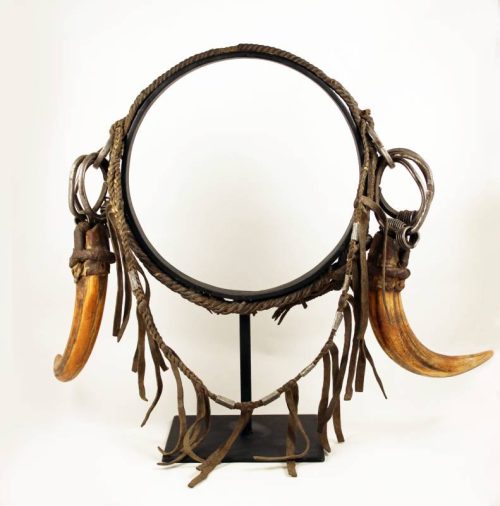 The headdress is worn with a braided leather band on the top of the skull and the side pendants made of teeth and metal elements adjoining the head of the wearer. Men wear this ornament as a symbol of status and bravery and women to enhance their beauty.The Mursi are a Nilotic pastoralist ethnic group in Ethiopia. Surrounded by mountains between the Omo River and its tributary the Mago, the home of the Mursi is one of the most isolated regions of the country. Materials: Warthog fangs, leather, iron, aluminium, vegetable fibres. First half of the 20th century. Provenance: Spanish private collection. Size with stand: 39 cm high x 45 cm wide with the fangs. Literature: “Joyas del Africa oriental”, Kumbi Saleh, 2006, p. 81 “Le Monde en Tete”, Seuil, 2019 P9535
 -
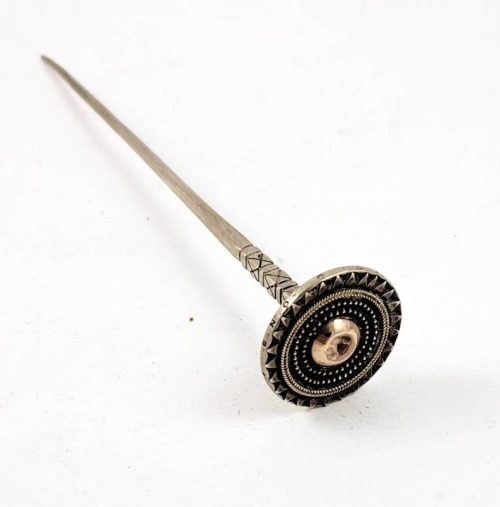 Rare hair pin made of high grade silver and suasa (an alloy of gold and copper), most probably from the Gayo Alas people of Sumatra (Indonesia). The top of the pin is made of two dutch old guilder coins, to which the pin was attached on one side and some applied decoration to the other side. From the 19th century or early 20th. Provenance: European private collection. Dimensions: Total length: 14,5 cm Top of the pin: 3 cm (diameter) P2085
 -
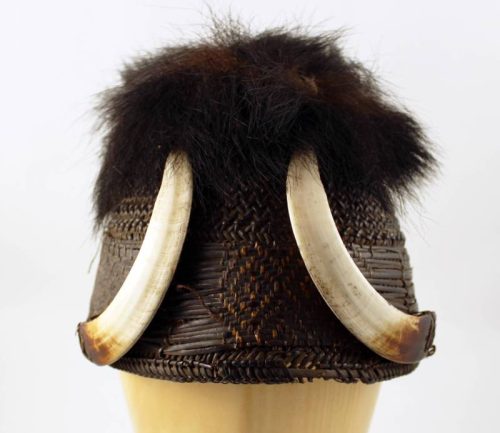 Naga warrior hat, from the Naga tribes inhabiting the hills around the Burma/India border. Materials: rattan, fur (according to Jacobs, it is usually bear's fur) and wild boad tusks. From the first half of the 20th century. Provenance: European private collection. Dimensions: 21 x 21 x 16 cm Literature: “The Naga”, Jacobs, Julian, Edition Hansjörg Mayer, 2012 “Naga, Awe inspiring beauty”, Draguet, Michel, Mercatorfonds, 2018 “Arte Naga”, Museo Nacional de Etnologia,Madrid, 1988 “Le Monde en Tete”, Seuil, 2019 CM00431
 -
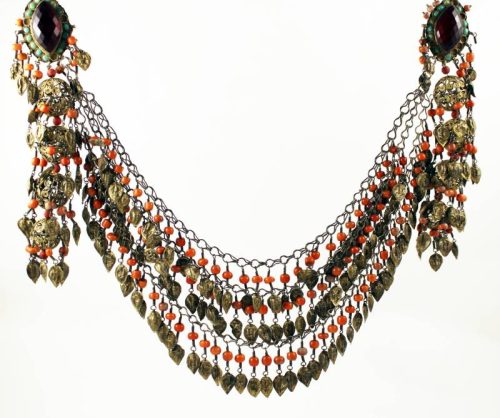 Uzbek jewellery ornament consisting in three rows of silver and coral beads with plait globular filigree hangings on each side. Khiva, Khorezm. The Khorezm bride added to her costume a pair of temple orament resembling earrings which wee attached to locks of hair on temples and linked by a necklace composed of strings of chains with stamped pendants. Gilt silver, coral, turquoises and glass cabochons. Provenance_ ex-Ghysels collection. 19th century. Literature: “Il corallo. Nell'ornamento dell'Asia islamica dalla Turchia all'Uzbekistan”, del Mare, Cristina-Vidale, Massimo, Electa napoli, 2001 “Uzbekistan. Heirs of the Silk Road”, Kalter and Pavaloi, Thames & Hudson, 1997, p. 292 “Il corallo. Nell'ornamento dell'Asia islamica dalla Turchia all'Uzbekistan”, del Mare, Cristina-Vidale, Massimo, Electa napoli, 2001, p. 52 “The arts and crafts of Turkestan”, Kalter, Johannes, Thames and Hudson, 1983, p.115 “Traditional jewellery from Soviet Central Asia and Kazakhstan”, Sovetsky khudozhnik Publishers, 1984, p. 55 “Le Monde en Tete”, Seuil, 2019, p. 115 CA280
 -
 Gold nose ring with pearls and gemstones, from Central Asia. Women of the various peoples of Turkestan wore similar nose ornaments. Their vernacular name, arabek, confirms their Arabic origin. Attached to the right nostril, they were meant to prevent the intrusion of evil spirits during inhalation. From the first half of the 20th century or older. Provenance: UK private collection Size: 4 x 4,3 cm Weight: 6,1 g Literature: “Parures de tête ethniques d'afrique, d'Asie d'Océanie et d'Amérique”, van Cutsem, Anne, Skira, 2005 “Schmuck aus Zentralasien”, Prokot, Inge and Joachim Callwey, Verlag München, 1981, p. 150 “Uzbekistan. Heirs of the Silk Road”, Kalter and Pavaloi, Thames & Hudson, 1997, 298 “Il corallo. Nell'ornamento dell'Asia islamica dalla Turchia all'Uzbekistan”, del Mare, Cristina-Vidale, Massimo, Electa napoli, 2001, p.74 PCA2
 -
 Gold nose ring with pearls and glass beads, from Central Asia. Women of the various peoples of Turkestan wore similar nose ornaments. Their vernacular name, arabek, confirms their Arabic origin. Attached to the right nostril, they were meant to prevent the intrusion of evil spirits during inhalation. From the first half of the 20th century or older. Provenance: UK private collection Size: 3,6 x 3,6 cm Weight: 6,8 g Literature: “Parures de tête ethniques d'afrique, d'Asie d'Océanie et d'Amérique”, van Cutsem, Anne, Skira, 2005 “Schmuck aus Zentralasien”, Prokot, Inge and Joachim Callwey, Verlag München, 1981, p. 150 “Uzbekistan. Heirs of the Silk Road”, Kalter and Pavaloi, Thames & Hudson, 1997, 298 “Il corallo. Nell'ornamento dell'Asia islamica dalla Turchia all'Uzbekistan”, del Mare, Cristina-Vidale, Massimo, Electa napoli, 2001, p.74 PCA3
 -
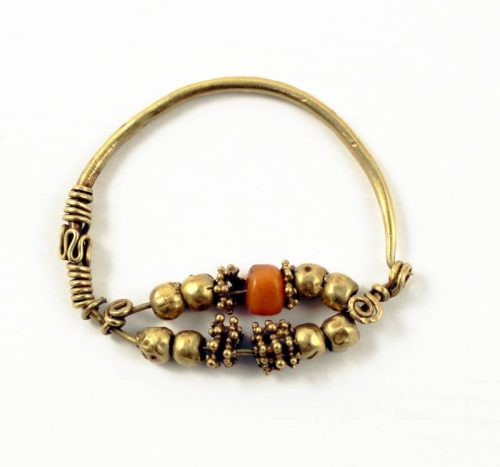 Gold nose ring with coral, from Central Asia. Women of the various peoples of Turkestan wore similar nose ornaments. Their vernacular name, arabek, confirms their Arabic origin. Attached to the right nostril, they were meant to prevent the intrusion of evil spirits during inhalation. From the first half of the 20th century or older. Provenance: UK private collection Size: 3,3 x 3,6 cm Weight: 5 g Literature: “Parures de tête ethniques d'afrique, d'Asie d'Océanie et d'Amérique”, van Cutsem, Anne, Skira, 2005 “Schmuck aus Zentralasien”, Prokot, Inge and Joachim Callwey, Verlag München, 1981, p. 150 “Uzbekistan. Heirs of the Silk Road”, Kalter and Pavaloi, Thames & Hudson, 1997, 298 “Il corallo. Nell'ornamento dell'Asia islamica dalla Turchia all'Uzbekistan”, del Mare, Cristina-Vidale, Massimo, Electa napoli, 2001, p.74 PCA1
 -
 Gold nose ring with coral and glass beads, from Central Asia. Women of the various peoples of Turkestan wore similar nose ornaments. Their vernacular name, arabek, confirms their Arabic origin. Attached to the right nostril, they were meant to prevent the intrusion of evil spirits during inhalation. Some of the granulation of the central rossette is missing. From the first half of the 20th century or older. Provenance: UK private collection Size: 4 x 3,5 cm Weight: 7,3 g Literature: “Parures de tête ethniques d'afrique, d'Asie d'Océanie et d'Amérique”, van Cutsem, Anne, Skira, 2005 “Schmuck aus Zentralasien”, Prokot, Inge and Joachim Callwey, Verlag München, 1981, p. 150 “Uzbekistan. Heirs of the Silk Road”, Kalter and Pavaloi, Thames & Hudson, 1997, 298 “Il corallo. Nell'ornamento dell'Asia islamica dalla Turchia all'Uzbekistan”, del Mare, Cristina-Vidale, Massimo, Electa napoli, 2001, p.74 PCA4
 -
 Indian gold nose ring with pearls, 22 kt gold, turquoise and glass beads. Worn in the North West area of Rajasthan around Bikaner and Jaisalmer. First half of the 20th century. Provenance: European private collection. Dimensions: 5,5 x 4 cm Weight: 9,9 gr. Literature: “Nose rings of India”, Ganguly, Waltraud, BR publishing Corporation, 2015 “Parures ethniques. Le culte de la beauté”, Geoffroy-Schneiter, Bérénice, Assouline, Paris, 2001 PIPIND
 -
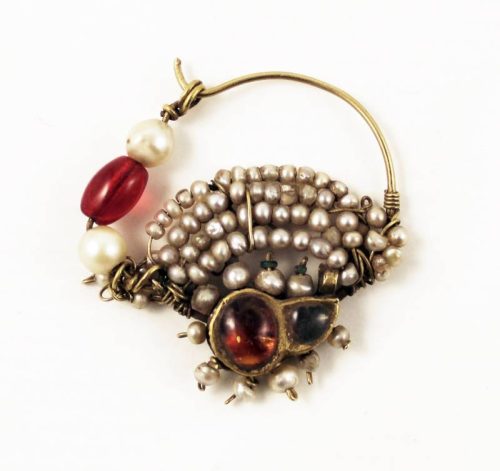 Indian gold nose ring with 22 kt gold, pearls, and glass beads. Worn mainly in Rajasthan . First half of the 20th century. Provenance: European private collection. Dimensions:3,2 x 3 cm Weight: 4 gr. Literature: “Nose rings of India”, Ganguly, Waltraud, BR publishing Corporation, 2015 “Parures ethniques. Le culte de la beauté”, Geoffroy-Schneiter, Bérénice, Assouline, Paris, 2001 PIPIND3
 -
 Indian gold nose ring with 22 kt gold, pearls, gemstones and glass beads. Worn mainly in Rajasthan . First half of the 20th century. Provenance: European private collection. Dimensions:3 x 2,7 cm Weight: 4,8 gr. Literature: “Nose rings of India”, Ganguly, Waltraud, BR publishing Corporation, 2015 “Parures ethniques. Le culte de la beauté”, Geoffroy-Schneiter, Bérénice, Assouline, Paris, 2001 PIPIND2
 -
 Indian gold nose ring with pearls, 22 kt gold, pearls and glass beads. Worn mainly in Rajasthan . First half of the 20th century. Provenance: European private collection. Dimensions:4 x 3,3 cm Weight: 5,5 gr. Literature: “Nose rings of India”, Ganguly, Waltraud, BR publishing Corporation, 2015 “Parures ethniques. Le culte de la beauté”, Geoffroy-Schneiter, Bérénice, Assouline, Paris, 2001 PIPIND1