-
 Old silver earrings or ear ornaments worn by Hmong tribe women in the Golden Triangle (close to borders of Thailand, Laos, Vietnam, Myanmar and SW China). Decorated on one side with engraved abstract designs. High-grade silver. Women wear these ornaments horizontally, attached to their chignons; the studs are worn in the ear lobe as shown in the last picture (old photograph). They could also wear them loose, just hanging from the earlobe. Dimensions: 28,5 x 11,5 cm. Both of them weigh 83,3 gr. Literature: “Parures ethniques. Le culte de la beauté”, Geoffroy-Schneiter, Bérénice, Assouline, Paris, 2001, p. 95 “A world of earrings. Africa, Asia America”, van Cutsem, Anne, Skira, 2001, p. 218-9 “The art of silver jewellery. From the minorities of China, the Golden Triangle, Mongolia and Tibet”, Skira, 2006, p. 151 “Peoples of the golden triangle”, Lewin, Paul and Elaine, River Books, Bangkok, 1998, p. 60 “Yunnan silver ornament”, Sun Helin, Yunnan people's Publishing House, p. 76 SEA529
 -
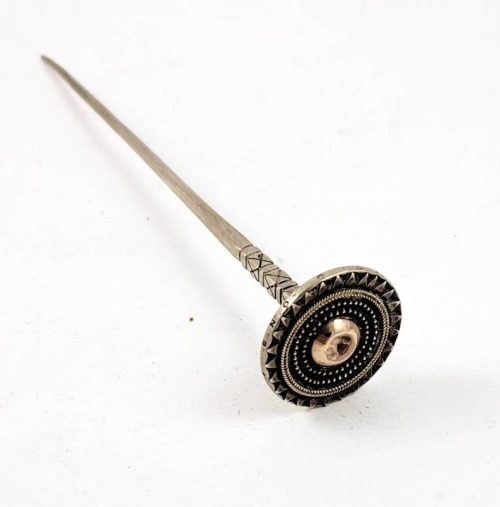 Rare hair pin made of high grade silver and suasa (an alloy of gold and copper), most probably from the Gayo Alas people of Sumatra (Indonesia). The top of the pin is made of two dutch old guilder coins, to which the pin was attached on one side and some applied decoration to the other side. From the 19th century or early 20th. Provenance: European private collection. Dimensions: Total length: 14,5 cm Top of the pin: 3 cm (diameter) P2085
 -
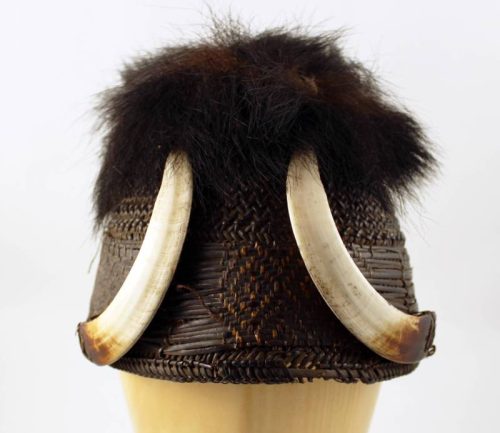 Naga warrior hat, from the Naga tribes inhabiting the hills around the Burma/India border. Materials: rattan, fur (according to Jacobs, it is usually bear's fur) and wild boad tusks. From the first half of the 20th century. Provenance: European private collection. Dimensions: 21 x 21 x 16 cm Literature: “The Naga”, Jacobs, Julian, Edition Hansjörg Mayer, 2012 “Naga, Awe inspiring beauty”, Draguet, Michel, Mercatorfonds, 2018 “Arte Naga”, Museo Nacional de Etnologia,Madrid, 1988 “Le Monde en Tete”, Seuil, 2019 CM00431
 -
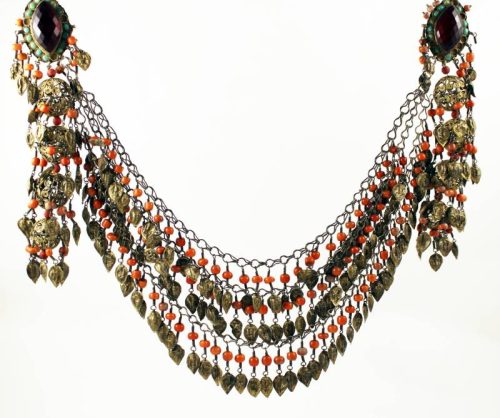 Uzbek jewellery ornament consisting in three rows of silver and coral beads with plait globular filigree hangings on each side. Khiva, Khorezm. The Khorezm bride added to her costume a pair of temple orament resembling earrings which wee attached to locks of hair on temples and linked by a necklace composed of strings of chains with stamped pendants. Gilt silver, coral, turquoises and glass cabochons. Provenance_ ex-Ghysels collection. 19th century. Literature: “Il corallo. Nell'ornamento dell'Asia islamica dalla Turchia all'Uzbekistan”, del Mare, Cristina-Vidale, Massimo, Electa napoli, 2001 “Uzbekistan. Heirs of the Silk Road”, Kalter and Pavaloi, Thames & Hudson, 1997, p. 292 “Il corallo. Nell'ornamento dell'Asia islamica dalla Turchia all'Uzbekistan”, del Mare, Cristina-Vidale, Massimo, Electa napoli, 2001, p. 52 “The arts and crafts of Turkestan”, Kalter, Johannes, Thames and Hudson, 1983, p.115 “Traditional jewellery from Soviet Central Asia and Kazakhstan”, Sovetsky khudozhnik Publishers, 1984, p. 55 “Le Monde en Tete”, Seuil, 2019, p. 115 CA280
 -
 Gold nose ring with coral and glass beads, from Central Asia. Women of the various peoples of Turkestan wore similar nose ornaments. Their vernacular name, arabek, confirms their Arabic origin. Attached to the right nostril, they were meant to prevent the intrusion of evil spirits during inhalation. Some of the granulation of the central rossette is missing. From the first half of the 20th century or older. Provenance: UK private collection Size: 4 x 3,5 cm Weight: 7,3 g Literature: “Parures de tête ethniques d'afrique, d'Asie d'Océanie et d'Amérique”, van Cutsem, Anne, Skira, 2005 “Schmuck aus Zentralasien”, Prokot, Inge and Joachim Callwey, Verlag München, 1981, p. 150 “Uzbekistan. Heirs of the Silk Road”, Kalter and Pavaloi, Thames & Hudson, 1997, 298 “Il corallo. Nell'ornamento dell'Asia islamica dalla Turchia all'Uzbekistan”, del Mare, Cristina-Vidale, Massimo, Electa napoli, 2001, p.74 PCA4
 -
 Gold nose ring with pearls and glass beads, from Central Asia. Women of the various peoples of Turkestan wore similar nose ornaments. Their vernacular name, arabek, confirms their Arabic origin. Attached to the right nostril, they were meant to prevent the intrusion of evil spirits during inhalation. From the first half of the 20th century or older. Provenance: UK private collection Size: 3,6 x 3,6 cm Weight: 6,8 g Literature: “Parures de tête ethniques d'afrique, d'Asie d'Océanie et d'Amérique”, van Cutsem, Anne, Skira, 2005 “Schmuck aus Zentralasien”, Prokot, Inge and Joachim Callwey, Verlag München, 1981, p. 150 “Uzbekistan. Heirs of the Silk Road”, Kalter and Pavaloi, Thames & Hudson, 1997, 298 “Il corallo. Nell'ornamento dell'Asia islamica dalla Turchia all'Uzbekistan”, del Mare, Cristina-Vidale, Massimo, Electa napoli, 2001, p.74 PCA3
 -
 Gold nose ring with pearls and gemstones, from Central Asia. Women of the various peoples of Turkestan wore similar nose ornaments. Their vernacular name, arabek, confirms their Arabic origin. Attached to the right nostril, they were meant to prevent the intrusion of evil spirits during inhalation. From the first half of the 20th century or older. Provenance: UK private collection Size: 4 x 4,3 cm Weight: 6,1 g Literature: “Parures de tête ethniques d'afrique, d'Asie d'Océanie et d'Amérique”, van Cutsem, Anne, Skira, 2005 “Schmuck aus Zentralasien”, Prokot, Inge and Joachim Callwey, Verlag München, 1981, p. 150 “Uzbekistan. Heirs of the Silk Road”, Kalter and Pavaloi, Thames & Hudson, 1997, 298 “Il corallo. Nell'ornamento dell'Asia islamica dalla Turchia all'Uzbekistan”, del Mare, Cristina-Vidale, Massimo, Electa napoli, 2001, p.74 PCA2
 -
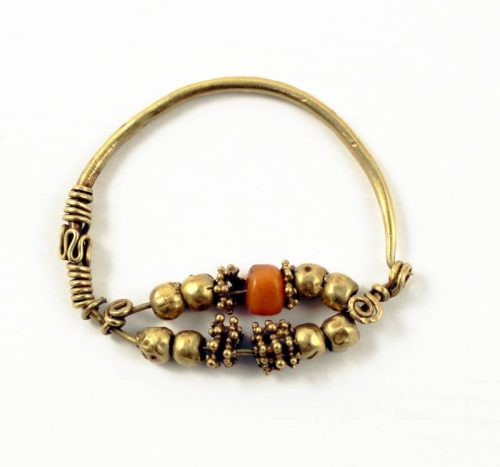 Gold nose ring with coral, from Central Asia. Women of the various peoples of Turkestan wore similar nose ornaments. Their vernacular name, arabek, confirms their Arabic origin. Attached to the right nostril, they were meant to prevent the intrusion of evil spirits during inhalation. From the first half of the 20th century or older. Provenance: UK private collection Size: 3,3 x 3,6 cm Weight: 5 g Literature: “Parures de tête ethniques d'afrique, d'Asie d'Océanie et d'Amérique”, van Cutsem, Anne, Skira, 2005 “Schmuck aus Zentralasien”, Prokot, Inge and Joachim Callwey, Verlag München, 1981, p. 150 “Uzbekistan. Heirs of the Silk Road”, Kalter and Pavaloi, Thames & Hudson, 1997, 298 “Il corallo. Nell'ornamento dell'Asia islamica dalla Turchia all'Uzbekistan”, del Mare, Cristina-Vidale, Massimo, Electa napoli, 2001, p.74 PCA1
 -
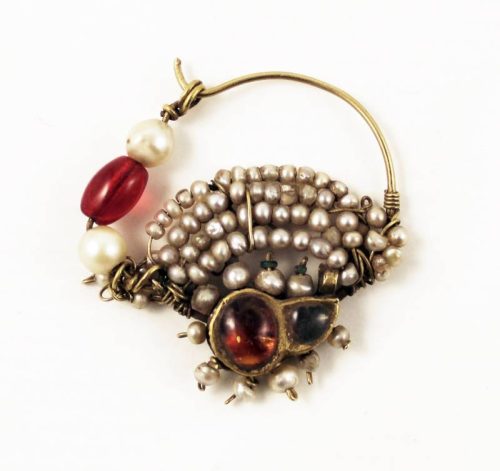 Indian gold nose ring with 22 kt gold, pearls, and glass beads. Worn mainly in Rajasthan . First half of the 20th century. Provenance: European private collection. Dimensions:3,2 x 3 cm Weight: 4 gr. Literature: “Nose rings of India”, Ganguly, Waltraud, BR publishing Corporation, 2015 “Parures ethniques. Le culte de la beauté”, Geoffroy-Schneiter, Bérénice, Assouline, Paris, 2001 PIPIND3
 -
 Indian gold nose ring with 22 kt gold, pearls, gemstones and glass beads. Worn mainly in Rajasthan . First half of the 20th century. Provenance: European private collection. Dimensions:3 x 2,7 cm Weight: 4,8 gr. Literature: “Nose rings of India”, Ganguly, Waltraud, BR publishing Corporation, 2015 “Parures ethniques. Le culte de la beauté”, Geoffroy-Schneiter, Bérénice, Assouline, Paris, 2001 PIPIND2
 -
 Indian gold nose ring with pearls, 22 kt gold, pearls and glass beads. Worn mainly in Rajasthan . First half of the 20th century. Provenance: European private collection. Dimensions:4 x 3,3 cm Weight: 5,5 gr. Literature: “Nose rings of India”, Ganguly, Waltraud, BR publishing Corporation, 2015 “Parures ethniques. Le culte de la beauté”, Geoffroy-Schneiter, Bérénice, Assouline, Paris, 2001 PIPIND1
 -
 Indian gold nose ring with pearls, 22 kt gold, turquoise and glass beads. Worn in the North West area of Rajasthan around Bikaner and Jaisalmer. First half of the 20th century. Provenance: European private collection. Dimensions: 5,5 x 4 cm Weight: 9,9 gr. Literature: “Nose rings of India”, Ganguly, Waltraud, BR publishing Corporation, 2015 “Parures ethniques. Le culte de la beauté”, Geoffroy-Schneiter, Bérénice, Assouline, Paris, 2001 PIPIND