-
 Hanuman pectoral plaque, India. Worn by ascetic devotees to Hanuman, especially in Karnataka (though encountered elsewhere) suspended from the neck. Hanuman, the celebrated celestial monkey chief and devoted follower of Rama, is held in great veneration all over India by Hindu Shaivas and Shaktas, but especially in the south by Vaishnavas, because of his humility, loyalty, and assistance to Ramachandra, the seventh of the ten incarnations (dasavataras) of Vishnu. Devotees believe that his worship imbues them with physical energy, fearlessness, and mental enlightenment. Material: bronze Age: 19th century or early 20th Provenance: European private collection Dimensions: 17 x 14,5 cm Weight: 334 g Literature: “Traditional jewelry of India”, Untracht, Oppi, Harry N. Abrams. Inc publishers, 1997, p. 108-10 "Unknown Masterpieces of Indian Folk and Tribal Art", Aryan, S. & B.N. Ayran, KC Aryan’s Home of Folk Art, 2016. "Change and Continuity: Folk and Tribal Art of India", Dursum, B., et al, Lowe Art Museum, University of Miami, 2004. IND1748
 -
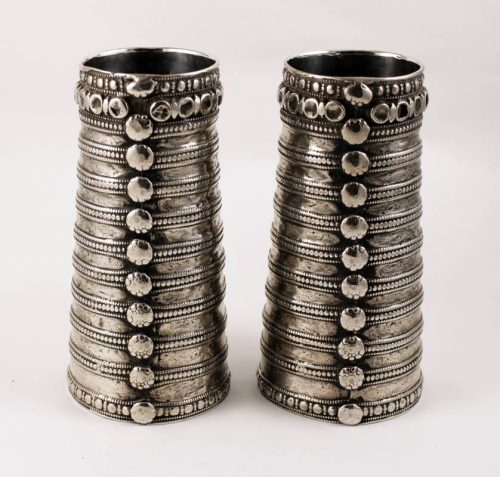 Pair of long bracelets from Rajasthan, India. Made of high grade silver. From the first half of the 20th century. Provenance: European private collection. Dimensions: Width: 16 cm Inner diameter: between 6 and 8 cm Combined weight: 573 g Literature: “Bracelets ethniques d'afrique, d'Asie d'Océanie et d'Amérique”, van Cutsem, Anne, Skira, 2002, p. 173 “Ethnic jewellery from Africa, Asia and the Pacific Islands”, The pepin Press, 2002 “Ethnic jewellery and adornment” Daalder, Truus, Ethnic Art Press, 2009 “Traditional jewelry of India”, Untracht, Oppi, Harry N. Abrams. Inc publishers, 1997 IND1734
 -
 Indian gold nose ring with pearls, 22 kt gold, turquoise and glass beads. Worn in the North West area of Rajasthan around Bikaner and Jaisalmer. First half of the 20th century. Provenance: European private collection. Dimensions: 5,5 x 4 cm Weight: 9,9 gr. Literature: “Nose rings of India”, Ganguly, Waltraud, BR publishing Corporation, 2015 “Parures ethniques. Le culte de la beauté”, Geoffroy-Schneiter, Bérénice, Assouline, Paris, 2001 PIPIND
 -
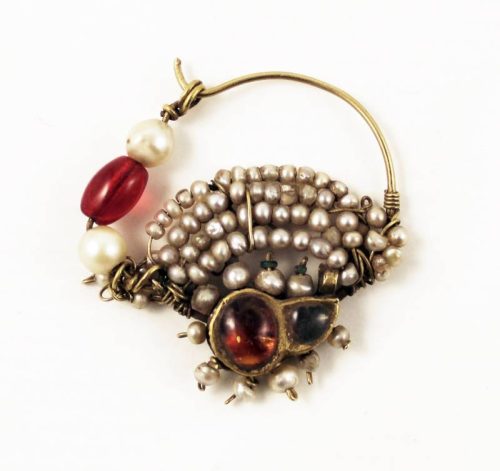 Indian gold nose ring with 22 kt gold, pearls, and glass beads. Worn mainly in Rajasthan . First half of the 20th century. Provenance: European private collection. Dimensions:3,2 x 3 cm Weight: 4 gr. Literature: “Nose rings of India”, Ganguly, Waltraud, BR publishing Corporation, 2015 “Parures ethniques. Le culte de la beauté”, Geoffroy-Schneiter, Bérénice, Assouline, Paris, 2001 PIPIND3
 -
 Indian gold nose ring with 22 kt gold, pearls, gemstones and glass beads. Worn mainly in Rajasthan . First half of the 20th century. Provenance: European private collection. Dimensions:3 x 2,7 cm Weight: 4,8 gr. Literature: “Nose rings of India”, Ganguly, Waltraud, BR publishing Corporation, 2015 “Parures ethniques. Le culte de la beauté”, Geoffroy-Schneiter, Bérénice, Assouline, Paris, 2001 PIPIND2
 -
 Indian gold nose ring with pearls, 22 kt gold, pearls and glass beads. Worn mainly in Rajasthan . First half of the 20th century. Provenance: European private collection. Dimensions:4 x 3,3 cm Weight: 5,5 gr. Literature: “Nose rings of India”, Ganguly, Waltraud, BR publishing Corporation, 2015 “Parures ethniques. Le culte de la beauté”, Geoffroy-Schneiter, Bérénice, Assouline, Paris, 2001 PIPIND1
 -
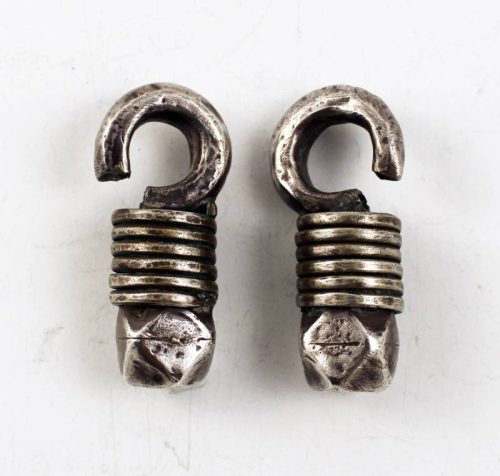 Vedha silver hollow earrings are worn by Bhopa Rabari women in Gujarat, India. This is the oldest type of Bhopa earrings and are now worn only by few old women. In India a large earlobe is a sign of strength and vitality. Provenance: European private collection. From the first half of the 20th century. Dimensions: 5,5 x 2 x 2 cm Weight: 46,8 g Gauge (approx.): 0,8 cm Literature: “A world of earrings. Africa, Asia America”, van Cutsem, Anne, Skira, 2001, p. 144 “Earrings. Ornamental identity and beauty in India”, Ganguly, Waltraud, B.R. Publishing Corporation, 2007, p. 98 “Traditional jewelry of India”, Untracht, Oppi, Harry N. Abrams. Inc publishers, 1997, p. 220 “Ethnic jewellery from Africa, Asia and the Pacific Islands”, The pepin Press, 2002, p. 135 IND1727
 -
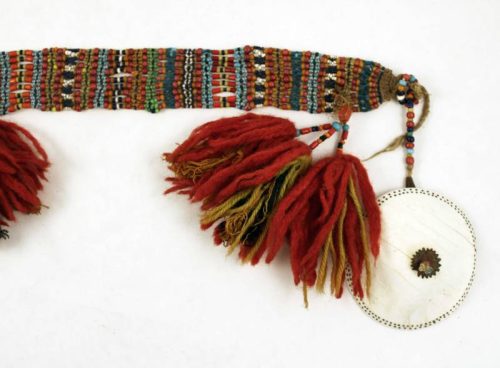 Conch shell ornaments used by Konyak men. The shell pieces are linked through a band made of tiny glass seed beads. Conch shell was highly appreciated by Naga people, as it had to be imported from the Bengala Bay. Materials: conch shell, glass beads, wool. From early 20th century. Dimensions: Shell ornament (each): 8,7 cm Beaded band: 46 cm Weight: 106,5 g Literature: “The Nagas”,Jacobs, Julian, Edition Hansjörg Mayer, 2012, p. 232, 233 “The Naga. Awe-inspiring beauty”, Draguet, M., Mercatorfonds, 2018, p.324 “A world of earrings. Africa, Asia America”, van Cutsem, Anne, Skira, 2001, p. 148-9 "Naga Treasures: Tribal Adornment from the Nagas – India and Myanmar", Giehmann, M., 2001
 -
 Big high grade silver anklets from Gujarat, India, with deep repoussé work. These type of anklets is worn by Maldhari women in this region. The big balls are attached to the anklets. These tinkling bells announce the presence of the wearer and at the same time repel insects and ward off the evil eye. Age: 19th century or early 20th. Dimensions: Total size: 13 x 11,5 cm Innner diameter: 7 cm Width: 2,2 cm Combined weight: 775 gr Literature: “Traditional jewelry of India”, Untracht, Oppi, Harry N. Abrams. Inc publishers, 1997, p. 273 “Indian Folk jewellery”, Ganguly, Waltraud, B.R. Publishing Corporation, 2015, p. 32 “Indian Jewellery”, Holbein Hendley, Thomas, BR publication, Delhi, 2009, p.pl. 64 “Vanishing beauty“, The Art Institute of Chicago, 2016, p. IND1138
 -
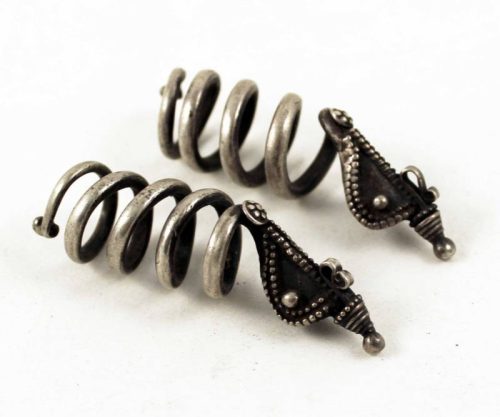 Silver earrins from Odisha called "nagulu", worn on extended earlobe holes, India. Nagulu were not specific to Orissa, but originated in Andhra Pradesh. The low caste Telugu farmers and weavers came to South Orissa in the 70s and introduced this genuine earrings design. They represent a female cobra, which is supposed to add protection to the woman wearing the earrings. From the first half of the 20th century. Provenance: European private collection. Dimensions: 4,3 cm long Weight: 23 gr Literature: “Earrings. Ornamental identity and beauty in India”, Ganguly, Waltraud, B.R. Publishing Corporation, 2007, p. 202, 203 “A world of earrings. Africa, Asia America”, van Cutsem, Anne, Skira, 2001, p. 145 “Ethnic jewellery from Africa, Asia and the Pacific Islands”, The pepin Press, 2002, p. 135 “Traditional jewelry of India”, Untracht, Oppi, Harry N. Abrams. Inc publishers, 1997, p. 219
 -
 Old silver pendant necklace, used as a lingam casket box. These pendants were designed as containers to hold a sacred lingam stone representing the god Shiva. High-grade silver. Lingayats are a Hindu group who believe that Shiva is the only diety, rather than the 3 gods revered by other Hindus. They also believed that the sacred presence of Shiva was not simply confined to the temple, but that it could be held in these pendants for a personal connection to the god. You can see similar samples in “Traditional Jewelry of India” by Oppi Untracht, page133. This is an original and worn piece, in excellent condition, from the 19th Century. It was kept in a European collection for decades. The size of the pendant is 7 cm wide by 4,8 cm high. The chain is 82 cm long approx. It weighs 108 gr. IND1148
 -
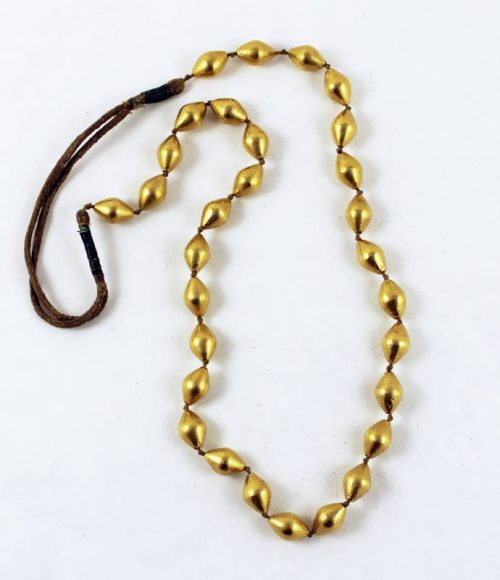 Vintage Indian gold necklace. These olive-shaped beads are made with 22kt gold sheets wrapping a wax core. From the second half of the 20th century. Provenance: European private collection. Dimensions: Size of the beads: 1,5 cm Total length: 62 cm Weight: 27,6 gr IND1715